Spiders have been a topic
of interest that continues to engage the children at Mairtown (click here for a
post I wrote a few weeks ago and to see how this line of enquiry began). I’ve mentioned
before how I particularly enjoy working alongside children on topics that
originate from their interests and in this particular case, it all began when
Sadie brought in a spider that she found at her house. Sadie’s infectious
enthusiasm naturally inspired other children’s interests, and this work has now
been on going for several weeks now.
We have learnt all about
spiders, especially New Zealand spiders. We have looked at their anatomy and as
the children’s questions and thoughts have guided this work, we have now moved
onto thinking about spider webs. As we began to look at webs, one idea challenged the children
and a question kept coming up, again and again. All the children wanted to
know, ‘How come spiders don’t stick to
their own webs?’
‘Great ideas have legs. They take you somewhere.
With them, you can raise questions that can’t be answered. These unanswerable
questions should be a source of comfort. Puzzlements invite the most precious
of human abilities to take wing. I speak of imagination, the neglected
stepchild of education’ (Eisner, The Satisfactions of Teaching)
Well, I thought this was a
great question to work on further, so that is exactly how we have spent the
last two weeks. As a teacher I love to encourage
children ‘how to think’ rather than teaching them ‘what to think’. I feel that by
fostering thinking skills in children, we open the world for them. Children,
who can think creatively and divergently are the world’s future problem
solvers, they will learn to deal with unexpected situations that arise and, as
research suggests, are more likely to be persistent, innovative adults who are
prepared to take calculated risks. These children will grow up to be the people
who can see lots of possible answers and many solutions to a single question.
So with that in mind, when
the question ‘Why don’t spiders get stuck
in their own webs?’ kept arising, I entrusted the children to think
divergently. I replied ‘Let’s use our
imaginations and play around with some ideas. I don’t know the answer but I
think it will be fun for us to think about it’.
‘Real learning is achieved through the
investigative process. Children have to be encouraged to search for the answers themselves. It is up to the teachers to
provide the tools and resources necessary for the children to conduct these
inquiries and make meaningful discoveries. One well-formed question will do
more to inspire than any number of answers. In every facet of our educational
pursuits, it becomes crucial to begin an open dialogue with our students, to
encourage healthy debate and to have them form their own conclusions.’(W.
Stanton)
As we played around with
these ideas and thought processes the children came up with many interesting
theories.
‘The potential of the child is stunted when the
endpoint of their learning is formulated in advance (Carlina Rinaldi)
Whereas I often use
drawing as an alternative and additional means of communication for children, to assist in deepening their
thinking, with this particular question I invited the children to use a
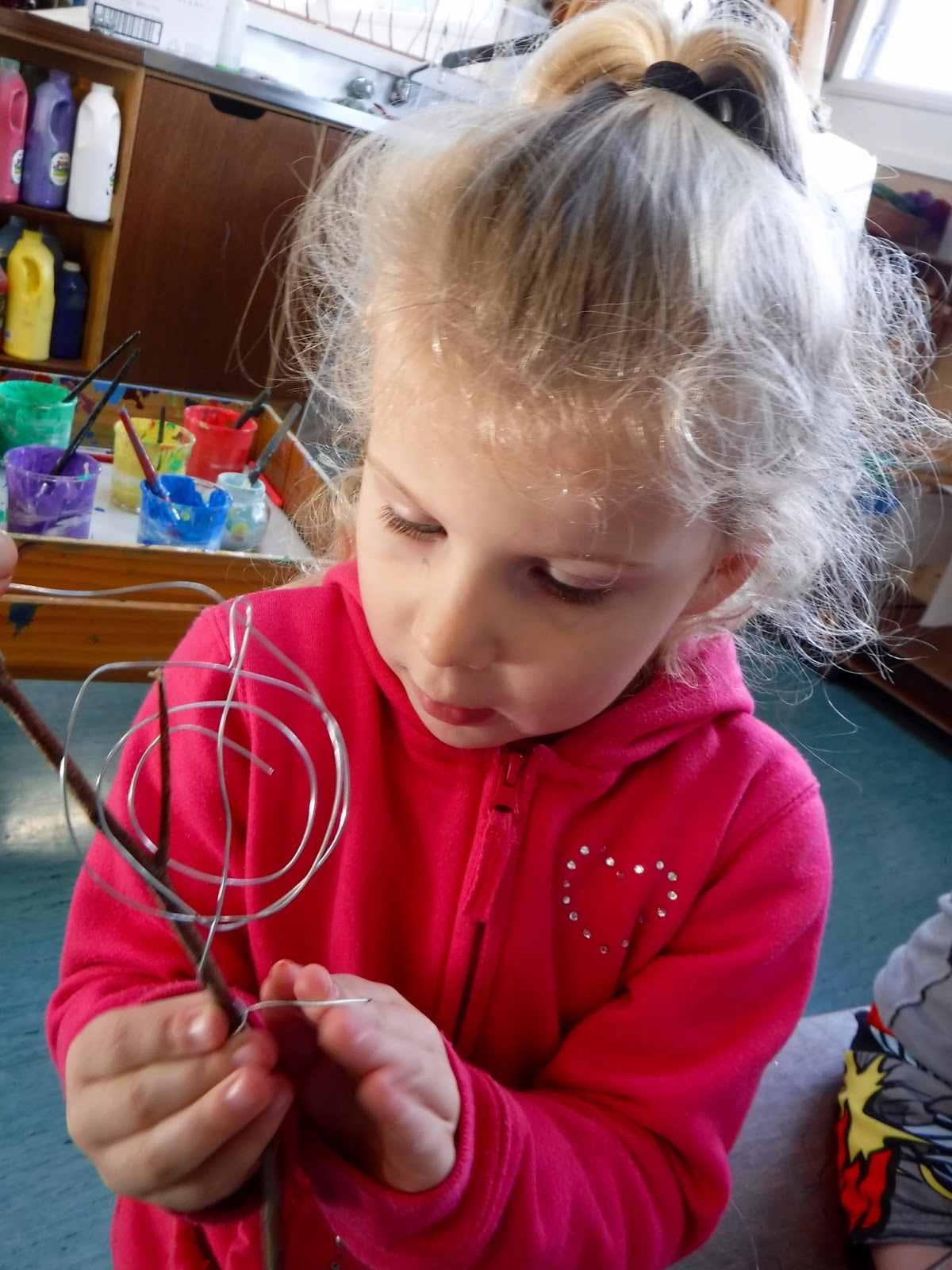
different medium as well - wire. Wire is such an interesting material to work with, it’s
responsive but can also be quite tricky to manipulate, personally however, I believe it is really worth
the challenge. Working with wire certainly seemed to enable the children to consider the
structure of a spiders web in more detail - its size and the intricate patterns
within - as they considered their question.

Here are some of the
children’s interesting theories to date, along with the beautiful webs they
have created - I think many spiders would be proud to have made such detailed
structures J
Taika: It’s because the flies, they are smaller than spiders, so they get
stuck and the big spiders don’t… hmm (after thinking some more)…oh I know, it's cause the flies fly so fast.
They go faster than the spiders so as they fly fast, they fly into the web and
get stuck, then the spider, it can just walk across to wrap it up ready to eat.
Peter: The spiders can crawl into their webs
easily, but the web, I think it is sticky for the flies, but it’s not sticky
for the spiders as they have really thin legs to help them crawl across the web
to get to the food.
Tyler: They don’t get stuck as it’s their own web
cause they made it, when they made it they made it with special stuff which
will stop them getting stuck.
Madison: So they make the web sticky for the flies to get stuck in it and spiders, they try not to get stuck because they don't have feet that stick, their feet are not sticking feet.
Sienna: I think it’s the legs, yes. Spiders have
long legs, that must stop them getting stuck.
Emma: Because they make the webs and they don't fly so they don't have wings, it's the wings that get stuck in the web.
Sadie: Cause they live in there, I don't see spiders on them (webs) but I do see flies. Spiders are very careful, they walk carefully. And flies do get stuck as they are not careful and just fly in.
‘As a small group of children explores the question
that most engages them, ask them to share their discoveries…the process of
telling the story of their work challenges children to consolidate their
understanding. As they hear the comments and questions of folks who haven’t
been part of their work, children encounter new ways to think about their work,
new questions to explore, and new strategies to try’ (Pelo, 2007)
I particularly love how the children have chosen to re-visit these webs over time. They are adding more details as they think about (and notice in our environment at kindergarten) other objects that get stuck in webs; we have seen leaves, a feather and even a piece of ribbon! Many children, as you will notice from the photographs, have gone a step further now, and are adding drawn spiders to their created webs along with some delicious prey ready for them to eat.
I can't help but wonder where next our work on spiders will take us.
Ngā Mihi,
Christine