Haere mai! Welcome to Mairtown Kindergarten's blog.

Nau Mai Haere mai. Welcome to Mairtown Kindergarten's blog.


21 Princes Street, Kensington, Whangarei, New Zealand

Phone: 09 437 2742

Email: mairtown@nka.org.nz

Monday, 17 October 2016

Pom and his chainsaw: authentic and real experiences at kindergarten


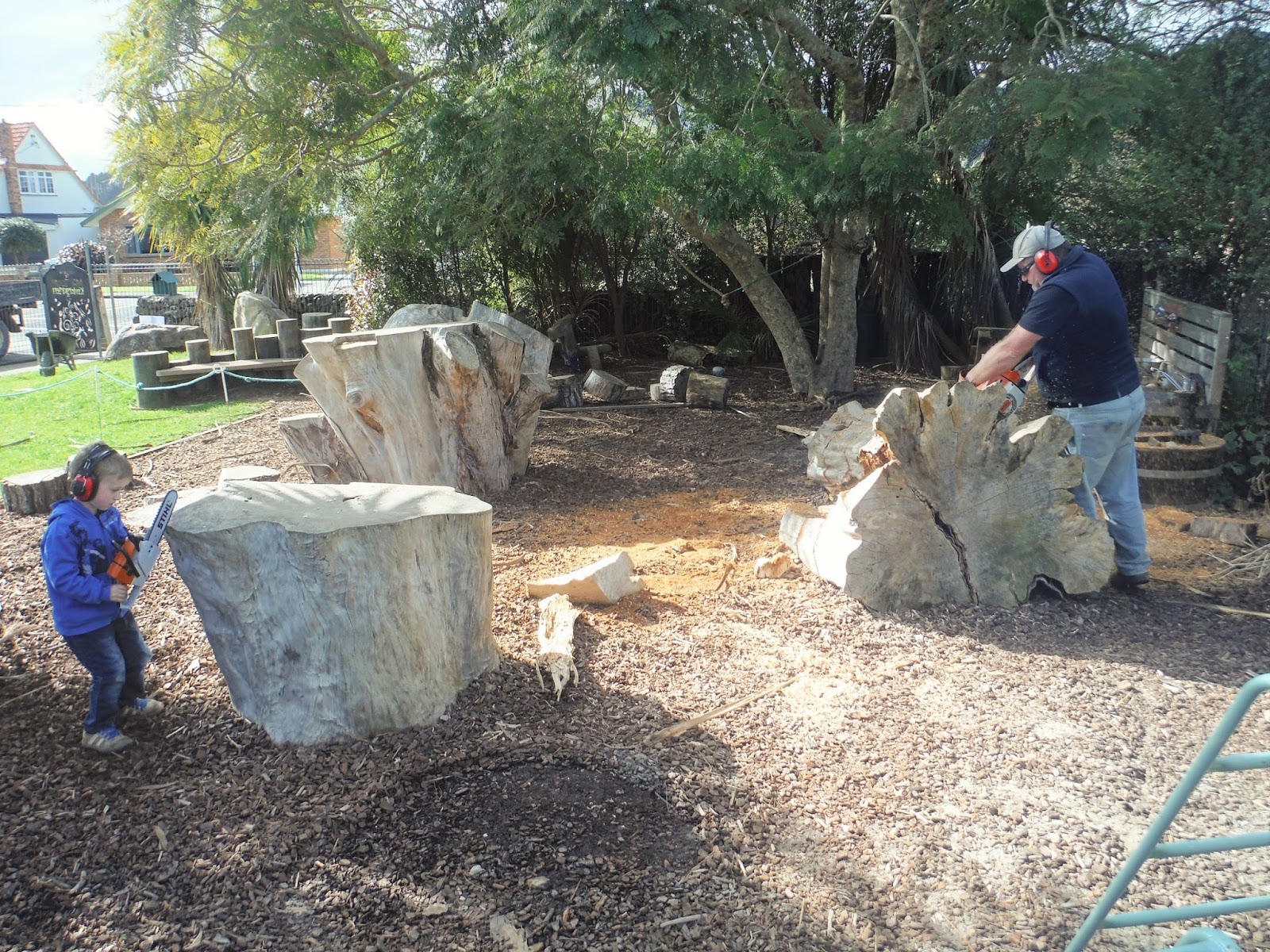
Early this year I wrote about how we discovered one of our logs had started to rot and the interest that this spiked for our children (click here to see this blog post). After a good few months of the children exploring what the rotten log had to offer we made the call to have it removed from kindergarten. We were very lucky that one of Donna’s good friends Pom offered to help us out by chopping it up and removing all the wood.


When Pom arrived with all his chainsaw gear some of the children got very excited. The teachers asked the children to stay behind a make-shift barricade. The children wore ear-muffs and safety goggles and they sat there eagerly awaiting. Alex in particular was very excited as chainsaws are a true passion of his. When he found out we were having a chainsaw coming to kindergarten on this day he asked his Dad if he could bring his toy Stihl chainsaw in. 


Also when other children noticed Pom and his chainsaw there was lots of talk about how they had experienced chain sawing in their world outside of kindergarten and what they knew about it. 


Being able to make a connection between these two contexts is very good for the children’s sense of belonging and socio-cultural development. Hedges and Cooper (2014) state that, “Teachers who partner with families can develop the capacity to recognise and utilise children’s family and cultural knowledge in educational settings to connect and enhance children’s learning.”


It blew me away how many children were joining us at this experience as I did think that the loud noise of the chainsaw would be a little off putting. Nearly all the children came along to see what was going on.


While Pom was chopping up the log he found some Huhu grabs and brought them over to the children. Some of the children straight away wanted to hold and look closely at them. 


We talked about what they were and how some people like to eat these grubs and that apparently taste like peanut butter! Everyone thought this was quite profound. 


This captured the interest for some children for a big part of the morning. They showed a lot of respect towards the grubs, returning them to the right places when they had finished observing them and role modelling some wonderful behaviour for their friends who were a little apprehensive about holding the grubs for themselves.


“Just as you are immersed in a natural world of sights, sounds, tastes, smells, and textures, early childhood environments should reflect the wonders of nature which surround us. As children interact with nature, they deepen their understanding and appreciation of their places and roles as the future caretakers of the planet.”

(Jessica Deviney)


The wood cutting took quite some time but the children were captivated by the fact that there was a man in our kindergarten during their play time using real machines to get this job done. This was such a great, real and authentic experience for the children to be a part of. They really enjoyed watching from a distance as Pom cut up the wood and once it was all chopped they happily and eagerly helped load the wood onto the back of the ute. Pom was blown away with how the children confidently picked up or rolled large chunks of wood to his ute.


Having experiences like this is great for children developing meaningful ideas and knowledge about their world. 

“Children understand and remember concepts best when they learn from direct personal experience.”  (Joseph Cornell)


The children spent the whole morning being involved in this event, from observing Pom skilfully cut up the log, engaging in many discussions with their teachers and peers about their knowledge and ideas about what was happening, to being hands on by physically helping remove all the wood from the kindergarten on to the ute. 


The children were very engaged and I felt like this was a very rich learning experience for them due to its holistic nature. Miller (2000) acknowledges that, “The art of holistic education lies in its responsiveness to the diverse learning styles and needs of evolving human beings.”


What I loved the most about this experience was that the children at our kindergarten were able to be a part of it. The logs are an integral part of our play space outside and I feel that we would be doing the children an injustice if we were to have the rotten log removed while they weren’t there. This is their place and I think that it is important to have the children involved in these genuine experiences that have such a big impact on their space. So much joy, interest, curiosity and meaningful learning was created.


Thank you so much to Pom for donating his time and skills to help Mairtown Kindergarten out. We really appreciated his support and also thank you to Donna for organising this. We now have a new space in our playground to plan for and think about which is exciting.

Ngā mihi nui,
Zair Taylor


Saturday, 24 September 2016

HAVE A HAPPY TERM BREAK

As another term ends we find ourselves reflecting on how it has been such a busy, engaging and full on time.

Many wonderful experiences have been had at Mairtown Kindergarten this term and the children have been very settled, happy and full of wonder.


The children have been displaying many beautiful ways of being towards one another, being inclusive in their play, showing care and empathy for others and being respectful towards all.


If you get a chance in the holidays pop down to the Whangarei Library where some of the children from Mairtown Kindergarten have lovely art on display.


We hope that over the term break you get to spend some quality time with your children, experiencing the beautiful moments and treasures that they bring to our lives.


"When children are given the gift of time the smallest things evoke the BIGGEST wonder."
(Bridget Miller)


 Have a happy and safe holiday.
Kindest regards
Team Mairtown

Tuesday, 13 September 2016

The power of imagination

I have been in the extremely privileged position to visit the Opal School in Portland, Oregon twice. My most recent visit was in June of this year. This school is an amazing place for an early childhood teacher like me, full of beauty, wonder, inspirational teachers and environments set up to provoke children’s wonder and imagination.


I gained an enormous amount of knowledge from each visit, but one thing that really stood out to me was their passion for encouraging children’s thinking and imagination. The power of the imagination is a factor I consider in my daily teaching as I see its full and wondrous potential for lifelong learning, yet at times I feel that imagination is pushed to the outside of learning and considered not particularly relevant or important in terms of education.


I’m often asked why, at Mairtown, we consider developing a child’s imagination to be so important? Why we support play not academics?  Why when we engage in inquiry work with the children we don’t give the answers to questions, but allow the children’s imaginations to take them on a journey of their own discovery. This is all because at Mairtown we want to develop children’s critical thinking skills, their creative problem solving – basically their imaginations - with imagination comes discovery and ultimately academics. We know that the only way to create human beings with imagination, is to provide them with opportunities to develop it for themselves when they are very young. These opportunities are found in one place - in play. Play is everywhere at Mairtown. It can be seen when children are creativity playing and engaging in the arts, when they are jumping off our wooden stumps with excited yells, when they are exploring on our nature programme, jumping in a puddle, are pretending to be mums and dads, or a bird gliding through the sky. At Mairtown we are surrounded by play every day.


“Imagination is more important than knowledge. For knowledge is limited to all we now know and understand, while imagination embraces the entire world, and all there ever will be to know and understand.” Albert Einstein


Many researchers and scientists consider that humans are unique in our endless capacity for imagination. Yet still I feel, imagination is a trait that is not valued or respected nearly as much as it should be.


So why do I believe that imagination is a fundamental aspect of education and learning. As Liu and Noppe-Brandon write, ‘imagination leads to creativity, which leads to innovation.’ I believe imagination is crucial to the future success of our youngest learners. This is backed up substantially by educationalists and researchers who claim that for young students, ‘imagination is the key to their successful lives. The kinds of workers that the world needs are problem solvers, who can look at problems from a different perspective and see many possibilities’ (Eisenhower). Community playthings, UK  agree when they state,Children are the world’s future inventors, physicists, and writers. Imagination enables the ‘possibility thinking’ essential for innovation. It opens new realms’You see, to be able to think of something that has not yet happened, to see something from another’s point of view, to think through strategies for a problem you have, all these require imagination.


‘Imagination is not just a cute faculty that children use to weave fantasies: it is one of the most effective tools in the learner’s toolbox. Scientists, designers and executives need a powerful imagination just as painters and novelists, and it can either be developed, through appropriate experience and encouragement, or left to shrivel up’ Guy Claxton


How do we foster imagination at Mairtown? Personally I feel a great deal of this is down to the image we have of the child. We are a group of teachers who see children as their own researchers with their own questions. We don’t always give children the answers all the time, we allow children to create their own questions, ideas and answers – even if at times - the answers given may seem a bit far-fetched to our adult minds.


‘Great ideas have legs. They take you somewhere. With them, you can raise questions that can’t be answered. These unanswerable questions should be a source of comfort. Puzzlements invite the most precious of human abilities to take wing. I speak of imagination, the neglected stepchild of education. (The Satisfactions of Teaching, Educational Leadership (63), 6)


We as adults also collaborate with the children, to wonder alongside them. You may hear us frequently asking, ‘I wonder why that happened, I wonder what that means, What does it make you wonder?  We allow children time to think and role model using our own imaginations ‘Let’s use our imaginations and play with ideas; I don’t know the answer but I think it would be fun for us to think about it’.


We work alongside the children in playful inquiry where we, as teachers, provoke and facilitate learning for our children without any specific, predetermined pathway or product in mind. We offer provocations such as open-ended questions, engaging environments, materials and loose parts for children to explore. And we give support by observing, listening, reflecting and encouraging dialogue.


We see play as an attitude and one that gives importance to the creative flow and joyful activity that children so naturally engage in.


 ‘The potential of the child is stunted when the endpoint of their learning is formulated in advance (Edwards, Gandini & Forman, 1998, The Hundred Languages of Children).


Hei konā mai,
Christine

Translate