Haere mai! Welcome to Mairtown Kindergarten's blog.

Nau Mai Haere mai. Welcome to Mairtown Kindergarten's blog.


21 Princes Street, Kensington, Whangarei, New Zealand

Phone: 09 437 2742

Email: mairtown@nka.org.nz

Thursday, 17 November 2016

Mairtown's 60th Birthday Celebration

There was much excitement when the start of term four began on the 10th of October, and so there should be as the tamariki were on the countdown to something worth celebrating. Something exceptional was happening on the 26th October and every day at whanau time the tamariki and kaiako would count the days until that very special Wednesday.


It was Mairtown Kindergarten’s 60th Birthday!!! Mairtown was the first kindergarten to be established in Whangarei in October 1956 and over the past 60 years has played an integral role in many children’s lives. We now have 3rd generation family members returning to be a part of our kindergarten community. Te Whaariki recognises that ‘The wider world of family and community is an integral part of the early childhood curriculum. Children’s learning and development are fostered if the well-being of their community is supported; if their family, culture, knowledge and community are respected; and if there is a strong connection and consistency among all the aspects of the child’s world’. The lead up to the big day was so much fun as the tamariki planned the event from what to wear, what to play and even worked together to make the incredible party decorations.


It was decided that on the day you could dress up as anything your heart desired. We had spidermen, Elsa princesses, pirates, construction workers and even ballerinas. We also decided to play party games such as the much loved favourite pass the parcel, musical statues and 'Simon Said' and of course there had to be prizes. A shared kai was planned to bring all our kindergarten whanau together.
 The day started much like every other birthday party would, the tamariki arrived and everyone was so excited to see what everyone was dressed up as, and of course the kindergarten was decorated beautifully with balloons and a long party paper chain (that the children had made leading up to the day). The place and everyone looked fantastic.


It was a busy morning as we had Zair, Kate and the help of Kate (Arlo’s Mum) on the face painting table inside and outside Christine had a table on the go making and decorating party hats. 

"I liked getting my face painted and eating cake" Milla.


Whanau time came around and we sang 'Happy Birthday' to Mairtown and Mia (as our youngest child here at kindergarten) got to put a birthday sticker on the wall wherever she pleased. The tamariki got into four little groups and we played pass the parcel, which was a real treat as the tamariki all ended up with a prize. We also had a special visitor come and say hello, his name was Greg. He shared with us that he went to Mairtown Kindergarten in 1958 and to this very day he is still friends with some of his kindergarten friends, which we all thought was super cool. 


 As the day progressed the excitement never ended with lots of other party games played along the way, musical statues, Simon says and musical bumps. The tamariki and kaiako were having a marvellous day. With party mode in full force there was something we needed to do next, to sit down together with our whanau and visitors to share in the delicious array of kai that the kaiako and whanau brought in to celebrate Mairtown’s 60th Birthday. Before we did that we needed to have cake because what’s a party if there’s no cake?


We all came together for a quick whanau time before lunch and we got to sing Happy Birthday to Mairtown again.  We thought it was fitting that Donna, Jane (Milla’s Mum) and Rafe (Lily’s Dad) who had attended Mairtown Kindergarten were asked to do the honours and blow out the candles on the cake. 

"I liked when my Dad got to blow out the candles and when we got to eat cake" Lily.


With the cake being done and the games all complete, there was only one thing to do, our mihi mo to kai so we could all go and enjoy the delicious food together. It was such a generous and delicious kai too. Thank you so much to all the whanau for bringing a plate of kai to share and taking time out of their day to be a part of this special celebration. We are so thankful to have such a wonderfully supportive community who come together for these types of events. The people of Mairtown are what make it and what continues to make it a beautiful place. 


“People coming together as a community can make things happen” (Jacob Rees-Mogg).


Can you spot Milla's Mum, Jane? 

A huge thank you once again to everyone that came along and joined us in this momentous occasion.

 He waka eke noa, We're all in this together.

From Kate


Monday, 7 November 2016

Hundertwasser inspired art, a beautiful tradition.


Each year at Mairtown, beginning in term 3, something exciting happens; the children begin creating their own individual art pieces ready to make into calendars, cards and diaries. This is a time of year that I love as a teacher at Mairtown; I love sitting down with each child, supporting them as they create, watching as their pieces unfold and noticing the pride and sense of accomplishment on each child’s face when they finally finish (after many days of effort).


At Mairtown, art and creativity is a very important aspect of our programme. We don’t see art as a rainy day activity or set our children up to create art pieces that all look the same and follow the same process, instead we cherish the arts. We offer children creative art experiences every single day, we provide good quality resources and support children as they begin their learning in the arts so they are successful, competent and proud of their effort and creations.


As we began our calendar work again this year, we called upon one of our favourite artists, one that our Mairtown children are true experts on, that of Friedensreich Hundertwasser. We have many lovely books at Kindergarten illustrating many of Hundertwasser's work, so the children were able to begin their work by choosing a piece of his that really captured their imagination and curiosity. When I sit and talk to the children about Hundertwasser's art pieces one thing I notice is how the children are naturally drawn to his use of bright, vibrant colours and how they interpret his pieces each in a very individual way, many seeing stories (they like to share with friends) in his work. I always encourage the children to dream and imagine, to tell and share their stories, to think about what a picture could be rather than what it is, as I firmly believe this strengthens their imaginative and critical thinking skills.


The creative arts are often thought of as unimportant, and are frequently the first programs to be cut when funds are low. However, the creative arts not only cultivate children’s imaginations, so that they become more flexible and inventive thinkers, but also help to develop their physical, emotional, and mental capabilities. As such, it is imperative that we work to integrate greater chances for young children to engage in the creative arts, for such measures will provide the foundation for later success (Chen, 2016)


What is so lovely about this kind of art is that as teachers we are able to work with just one or two children at a time. This allows us to thoroughly discuss and examine in depth the art that has provoked each child and we are part of witnessing, listening and observing each child’s creative wonderings. Over the months we engage with children on this work we can also see how children develop skills of sharing ideas, of using their imaginations and of building up a collection of ideas that ultimately enable them to see and appreciate perspectives which are different to their own.


‘Children’s interest in making art is increased if adults encourage them to talk about art and artists – who artists are and how they make things’ (Douglas, Schwartz and Taylor, 1981).


Despite inviting all our children to create a piece of art, a busy time for us, we are very mindful as teachers to support the children in an unhurried manner, never to rush or push their creativeness at a pace the children are not happy or comfortable with. Art pieces such as these take a great deal of time. We begin work with black vivid, later adding coloured dye and finishing with highlights of gold and silver pens. Although only seemingly a three step process, for children, who are still developing strength in the small muscles of their fingers, each step may be broken down into several more steps. Whilst some children love to try and finish so they can see their finished product, others take longer, enjoying the process of contemplation, of re-visiting, of adding on a little here and there, of watching their art pieces slowly develop.


‘Play and the creative arts in early childhood programmes are essential ways children communicate, think, feel and express themselves…Children succeed when they have access to a wide variety of art-making materials…and when they are surrounded by adults who see and believe in the creative competence of all children and are committed to their success in expressing themselves…Given these optimum circumstances, children surprise and delight us – they create structures and thoughts no one has seen or heard before’ (Drew and Rankin, 2004).


For many children creating an artistic piece is a risk and a challenge, and again working one-on-one or in small groups allows us as teachers to support these children in their endeavours to take that risk, to try and to experiment, after all this is how we gain the confidence in life that anything is possible.

Although we may have used Hundertwasser’s art as a provocation for the children’s work, I feel it is still vital for the children to make their own choices. In this year’s work, some of our children decided not to use Hundertwasser but created work inspired by the things that interest them personally. Each child has approached his/her creation differently; there was no right or wrong way to begin or to finish and as such the pieces once again this year are totally stunning.

Here are a few of this year’s collection I’d like to share with you:


At Mairtown we see all children as creative – full of imagination and wonder. We provide children with the tools to fuel their imaginations and to explore the language of art, I hope you have enjoyed looking at this year’s art, and know many of you will have some of these wonderful pieces hanging on your walls come the new year.

Until next time,
Christine


Monday, 31 October 2016

Tell me a dragon


Last term, many weeks ago now, we borrowed a book from our local library called 'Tell me a dragon', written by Jackie Morris. This book has inspired many stories over these weeks along with  some rather magnificent works of art. It is always interesting, from a teachers perspective, to observe what piques a child’s interest (such as this book), and we are so fortunate as early childhood teachers to take this interest and passion, negotiate with our children what the next steps will be and then watch the learning unfold.

For those that don’t know this book, it is beautifully illustrated with dragons, everyone in the book has their own dragon! The book describes many different varieties of dragons and tells a story in words and beautiful pictures as to why they are so special and enchanting to their owners. The dragons in the book vary from one that is as big as a whole village to another that is so small it can fit behind its owner’s ear.


Something I have written before, but springs to mind again as I write this, is just how important it is as teachers to listen and observe the needs, wants, interests and passions of young children. Instead of us dictating to the children what their learning on dragons would look like, as teachers we were careful to plan for learning with these simple questions in mind - Who is this child right now in front of me, What are their interests and learning intentions and, How as a teacher can I support and facilitate this?


Before we knew it, Mairtown was awash with dragons, with dragon art, and dragon stories. This was deepened even further when one of our children, independently arrived at kindergarten one morning with a clear plan. She wanted to create some more dragon art work (she was now an expert on dragons!) but in a 3-dimensional manner. As teachers, we observed something new unfold at this time; new ideas for creativity, problem solving, role modelling and lots of peer tutoring. Something beautiful happened, the dragons being created started to come alive in the art, and as the children worked on their pieces, over many days, they shared stories about their dragons with one another and their imaginations blossomed.


Art can bring imagination to life and give life to imagination’
(Dogra, 2010)


It appeared to me that when children went from drawing their dragons flat (in a 2-dimensional manner) to cutting them out, standing them up and placing them on a background they had also created – everything was different - yet special. By different I mean children saw new and exciting possibilities, possibilities they were not even aware of themselves when they began their work. A single tree turned into a forest, a flower into a colourful garden. This visual surprise spoke powerfully to their imagination (Kolbe, 2005).


The children spent days and days on their work, re-visiting and altering, adapting and tweaking their dragon habitats. From a purely cognitive learning approach this work was a challenge for many. It takes time to understand that when you enter the world of 3-dimensions you need an adequate base to make things stand up. Many children went even further utilising other resources available to them, creating dragons out of clay and re-found materials.


‘By exploring art, revisiting ideas and providing a range of media, a child’s skill in the arts increases, this in turn extends communication, vocabulary and critical thinking skills.’ 
(Ann Pelo, 2007)


Of course just like the original book ‘Tell me a dragon’ all the children’s dragons were enchanting and special to them, each with a unique story of their own. Here are just a few to share with you.

Capri ‘My dragon is a girl, her name is Lala. She lives in a house where she plays with cars. She breathes out bunnies. She’s a friendly dragon.

Evan ‘My dragon is a big dragon; it flies in the sky to visit the zoo. It visits the zoo as it eats elephants and elephants live in the zoo. In fact, it eats lots of animals, lots that live in the zoo!’

Milla ‘This is a fire dragon. He breathes only flowers and lives in his castle. He does it when it’s nearly dinner time as he likes to practice breathing flowers. His name is rainbow.’


Wolfgang ‘He is a happy dragon. He lives in a spiky cave with claws. My dragon flies and jumps and chomps. It eats vegetables, carrots, potatoes, and mushroom. It’s called Kate.’


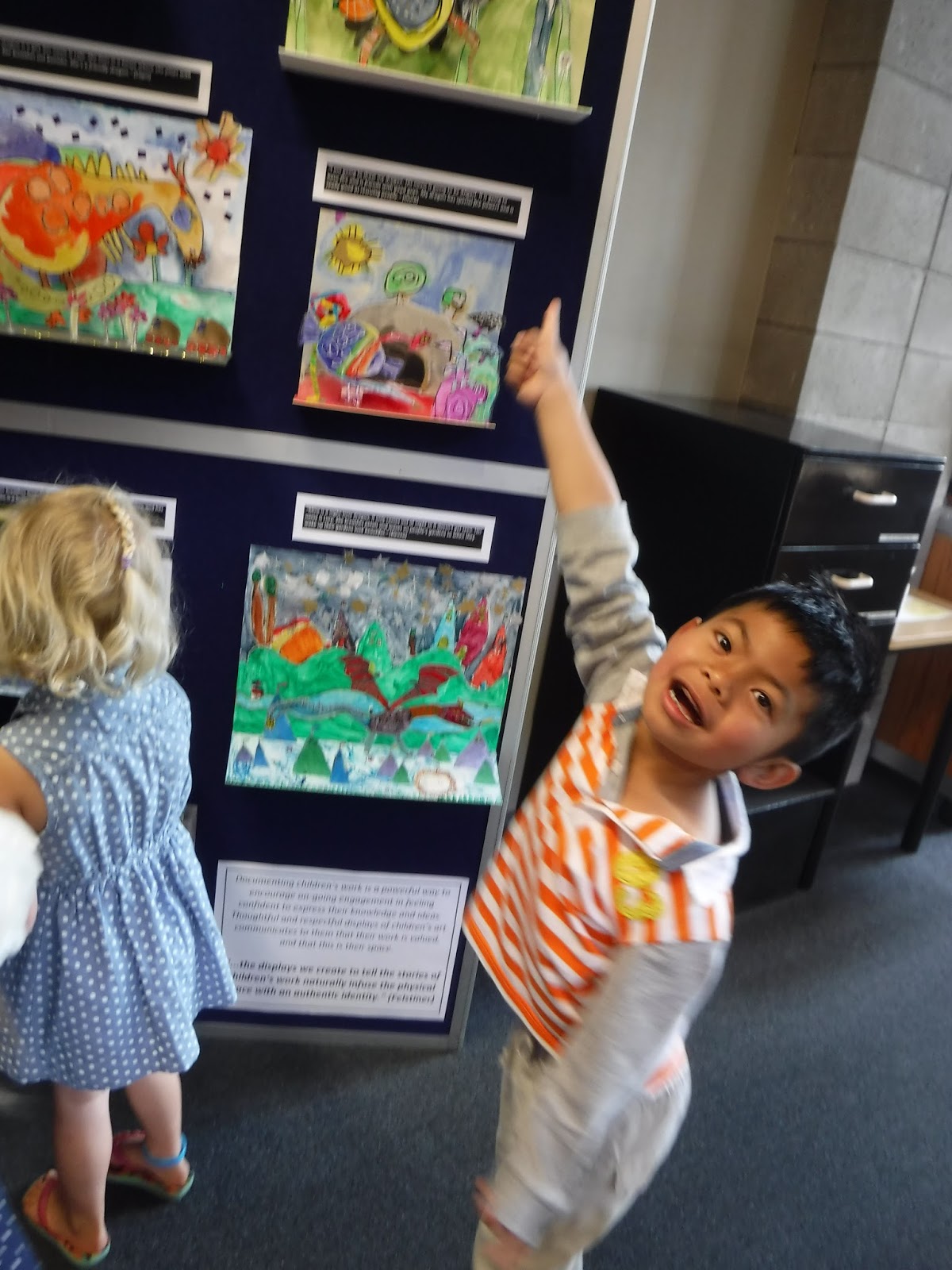
Now many weeks later, we reach the end of our dragon stories (perhaps just for now). Last week I took a small group of the children who had created their dragon stories to the Whangarei Central Library where they had been on display for a library open day. Any trip is exciting, but the underlying theme of this visit was the empowerment the children received as they saw their work on display, being admired and valued by members of our community. The feedback we have received from the public about their talents and skills is very special indeed. Making public the children’s work and processes behind their pieces also acts as a form of communication to our local community, opening up a public conversation about what we as teachers (and our children) value about children’s learning and of course the importance of creativity and imagination.


In Albert Einstein’s words, ‘I am enough of an artist to draw freely upon my imagination. Imagination is more important than knowledge. Knowledge is limited. Imaginations encircles the world’


Ngā mihi nui,
Christine Alford


Translate