Haere mai! Welcome to Mairtown Kindergarten's blog.

Nau Mai Haere mai. Welcome to Mairtown Kindergarten's blog.


21 Princes Street, Kensington, Whangarei, New Zealand

Phone: 09 437 2742

Email: mairtown@nka.org.nz

Monday, 24 February 2020

How can tree climbing be valuable learning?


Last year we were asked to support Sue Stovers with her presentation ‘climbing trees’ at the NKA conference.  This opportunity got me thinking, how can tree climbing be valuable learning for our tamariki?  How do we challenge our children to reach their ‘risk taking’ goals?  And does it actually help children to build resilience in our kindergarten environment?


“To climb a tree is for a child to discover a new world”.  (Friedrich Frobel)


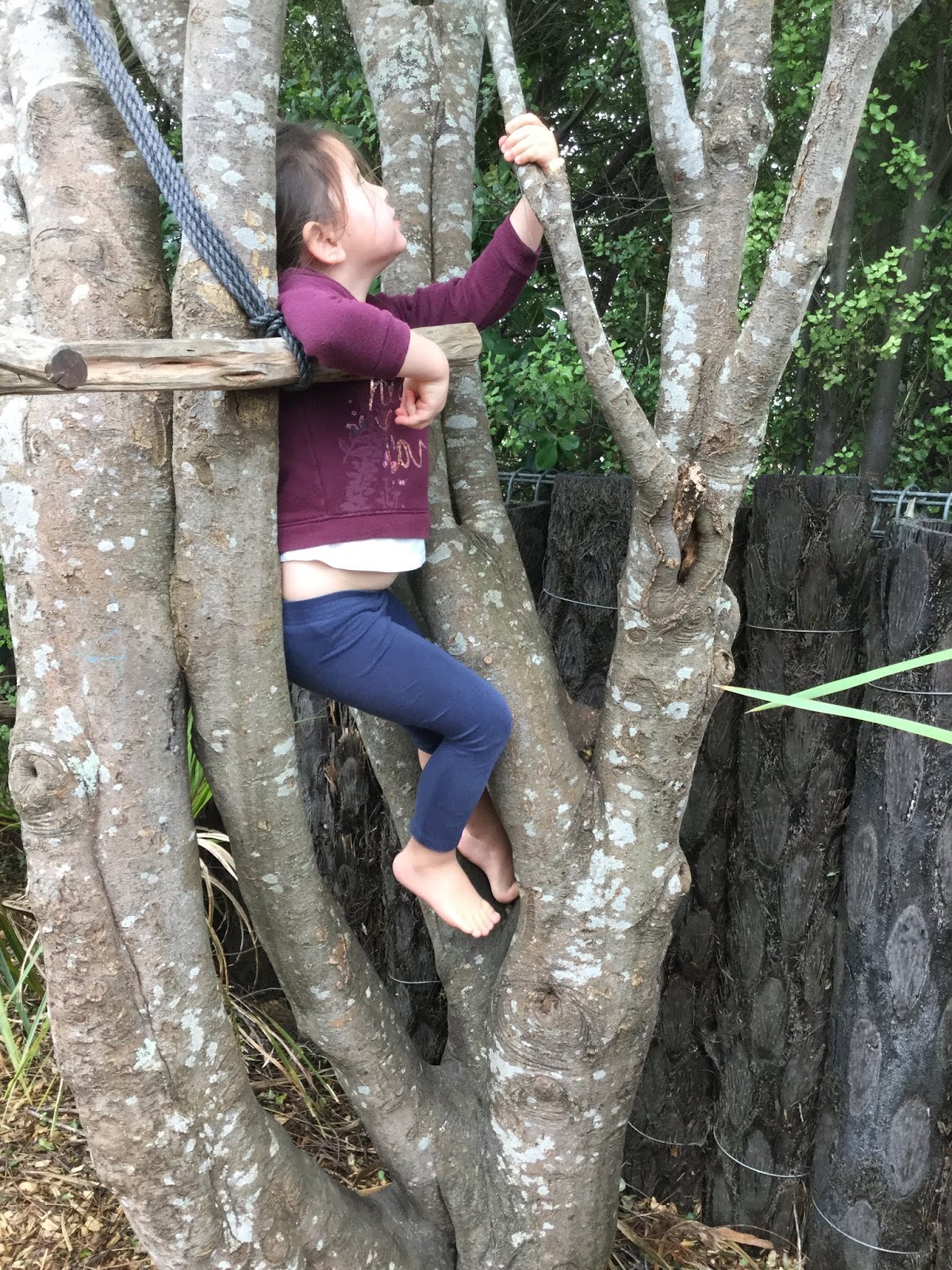
At Mairtown kindergarten we are all for children taking responsible risks within their learning.  Risk taking can be viewed in many different ways and forms, and climbing trees is one way we promote it.  We believe it is highly important to have a risk rich environment, this is underpinned through our image of the child, that they are capable, confident and competent lifelong learners. Our environment promotes a nature based curriculum and we are fortunate to have trees of varying sizes for our tamariki to explore and learn to climb.  We also have our monkey bars attached to our big trees, this is an excellent starting place to gain physical strength and confidence to climb.   

“Daily small manageable risks add up to big gains in a child’s self-esteem and self-confidence over time”.  (Nell Regan, 2018)


The teaching team all value the importance of children learning how to climb trees for themselves.  There is no way to rush the process, it takes time for children to develop their muscles and build up their physical strength and confidence, to gain the knowledge that they are strong enough to achieve their goals.  We are lucky to have many wonderful rangatiratanga who can lead by example and role model how to climb.  It is crucial for children to learn how to get themselves up the tree by them self and then they will instinctively know how to get back down again.


“Raise them with an inch of caution, a mile of freedom, and a bucketful of strength.  Children need our courage, not our fear”.  (N. Ryan)


There is no doubt that tree climbing can be both dangerous and safe.  I know for some adults the thought of children climbing high up in trees is terrifying, however, for me seeing children running on the concrete is far more concerning, I would rather see them up a tree.  To children, a climbable tree is a provocation, a challenge, something to conquer.  I believe that the adult’s attitude and/or fears towards tree climbing can have a huge impact towards the learning being successful or negative.  I have always loved nature and grew up climbing trees from a young age, mainly because I really wanted to get up into our tree hut where my older brother and sister were playing. 


I highly value the importance of trees and I think it is great how much valuable learning develops through learning to climb trees.  I believe it is important for children to learn to trust their own gut instinct and understand their own limits to navigate climbing trees. 


“Taking risks in play is essential for children’s growth and development.  Risky play can help children learn their strengths and weaknesses and become more aware of their limitations so that they can learn to take care of themselves".  (Nell Regan, 2018).

It is interesting to observe children learning to climb trees.  It is like they instinctively know how high to climb; finding that point where they feel safe as they learn their own limitations, about their bodies and perseverance.  This is all valuable learning and wonderful life long skills, which children will use widely throughout their life and educational journey.  I love that climbing trees is so beneficial for all tamariki, not only physically but also emotionally.  I also feel it is important to respect children’s goals, whether we think they are big or not.  Sometimes it takes lots of little goals to achieve the big goal.


Research states that “Tree climbing is a risky play activity that has many benefits for the developing child. Kids love the challenge of climbing trees. The physical challenge creates a boost to a child’s self-esteem and the feeling of accomplishment.  There is also a mental challenge to climbing trees. Focusing on “solving the problem” of how to get up the tree creates a resilient “I can do it” attitude when faced with both mental and physical problems in the future.  Some researchers in Florida have measured the cognitive benefits of risky activities like tree climbing.  They found that using your mind to navigate through the tree and operate your hands and muscles while climbing has a tremendously beneficial effect on your cognitive abilities. The improvement in working memory is one of the skills they measured to have marked improvement”. (Nell Regan, 2018). 


This term we have had new children join our kindergarten whānau and it has been lovely to see them rise to the challenge of learning to climb trees and tackle the monkey bars.  I believe it is like anything in life, having a positive attitude goes a long way.  As a teacher, I find it rewarding to see our tamariki conquer doing things that may make them feel a little worried, then use the opportunity to assess the risk and take a responsible risk to master the feeling of achievement.  Indeed all valuable learning.


“The more risks you allow your children to make, the better they learn to look after themselves”.  (Roald Dahl)

Mā te wā
Susie

Wednesday, 18 December 2019

Christmas Aroha


Aroha mai, aroha atu | Love received, love returned. 


The festive season is fast approaching! After a year which has seen many changes at Mairtown kindergarten, this time provides an opportunity to pause in the midst of all the busyness and reflect on how grateful we are to share our beautiful space with such wonderful tamariki and supportive whānau. We are also grateful that together we continue to experience and celebrate the aroha held within our familiar festive rituals and traditional events as our kindergarten year draws to a close.
Aroha is not something anyone can expect to command from others because they imagine it’s their right. To accept and enjoy the loving, the sharing, the caring of aroha means you give back a little more than you received. This keeps the networks of aroha alive and functioning. (Tilly Reedy, 1979).


The Christmas tree festival at St Johns Church is a community event our tamariki have enjoyed being part of for a number of years now, and preparations for this much anticipated event begin in November. The tamariki of Mairtown kindergarten love to sing, and practicing our Christmas songs marks the beginning of our festive activities. Christmas decorations with a theme of sustainability are created to adorn our tree, and this year we were blown away by the creativity demonstrated in the beautiful peg fairies, gold and silver painted shells and leaves and twig stars which were carefully crafted. When all were complete, the teachers took them to the church and decorated our beautiful Mairtown kindergarten tree.


We counted down the days to our ‘Christmas tree walk’ on our calendar, until finally the morning came and our fabulous whānau helpers arrived to join us on our walk along the streets of Kensington.


Our tamariki were so excited to see their own tree standing proudly among those decorated by many other community organisations. We then gathered together, Rev Bob told us a Christmas story and the church team offered refreshments. It was then our turn to give thanks to them for their hospitality, by enthusiastically singing them our prepared Christmas songs. We then left to return to kindergarten, knowing that our beautiful tree, along with its companions, will be giving pleasure to all who view it during the festival.


Another special festival ritual at Mairtown kindergarten is the creation of our gratitude tree, which celebrates the specialness of our tamariki. We offer whānau the opportunity to write on the back of a beautiful photo of their child, sharing with them their thoughts about why they feel grateful to have them in their lives. This card is then displayed on our special tree until the end of the year, when it is gifted to the child to take home and hang on their own tree. Tamariki love spending time looking at these cards, and hearing the heartfelt words shared on them. The messages reinforce to them the aroha which surrounds them.


As we count down each day of December, a child opens the appropriate drawer of our advent calendar to reveal a beautiful bauble, which they then hang on the gratitude tree. So as the days pass, our tree becomes ever more lovely.
Modelling thankfulness can help instill the character trait of gratitude and caring in your child’s life. Don’t miss an opportunity to model and teach kindness, gratitude and compassion. These are character traits that can enhance your child’s overall growth and development and can buffer your child against a culture that often concentrates on “me” first (Innis, 2013).


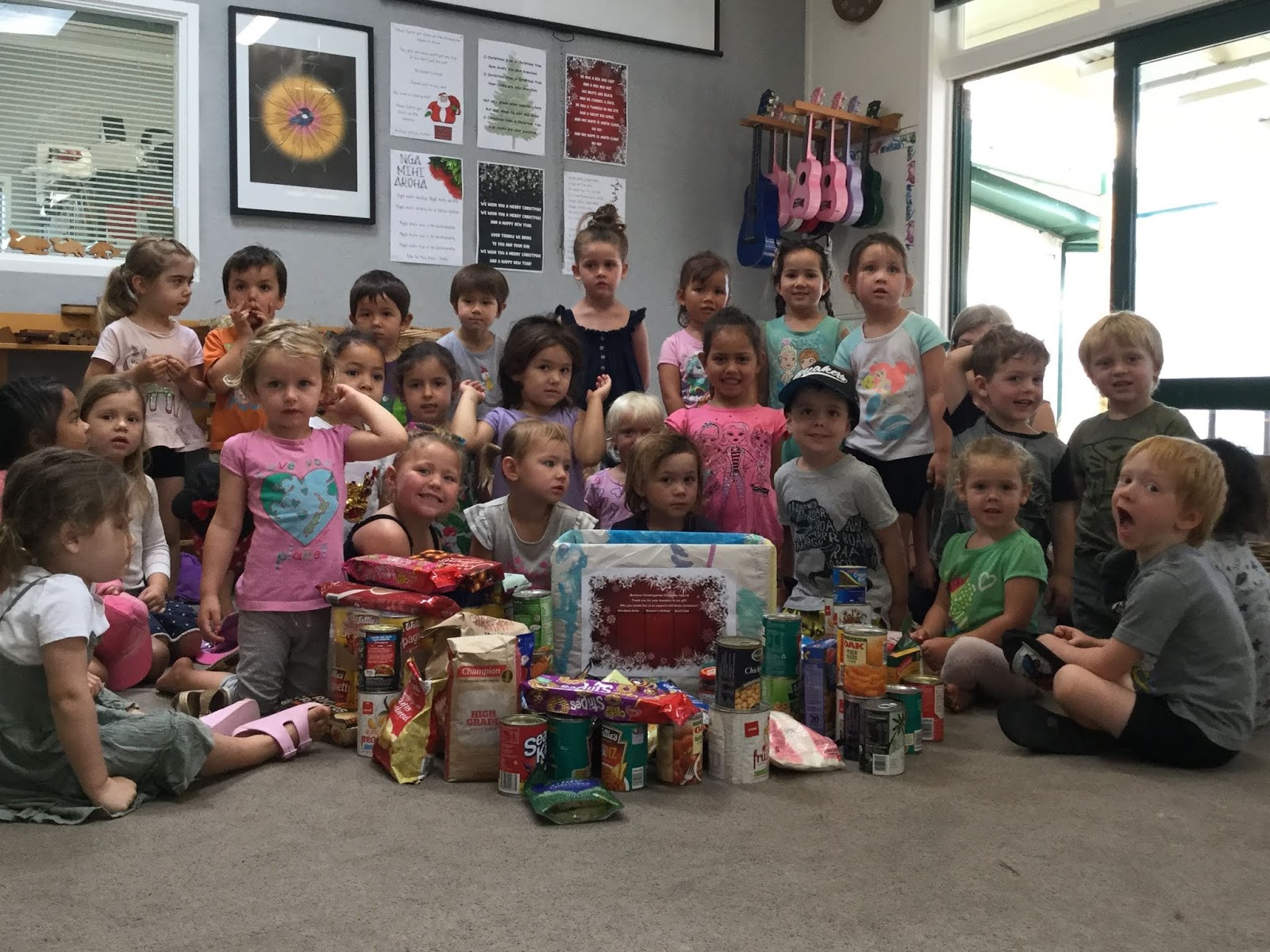
Manaakitanga is the bedrock of Mairtown kindergarten, and we believe the Christmas season provides an important opportunity to reflect on and be grateful for the special people and gifts in our own lives; and in some way to offer our support to those less fortunate in our community. This year we invited our kindergarten whānau and tamariki to join us in providing a gift of food to an organisation supporting families in need this Christmas, and we were overwhelmed with the generosity of the response As a result, the tamariki were able to participate in preparing hampers for both Women’s refuge and Soul Food. When we showed them the food which had been gifted during whānau time, their responses were heart-warming, for example “We already have enough, now someone else can be happy too”.

He aroha whakatō, he arohaka puta mai. | If kindness is sown, then kindness is what you shall receive.
Aroha is giving with no expectation of return. Aroha is the basis of strong whānau [who] let each member know on a daily basis, through words or actions, that they are loved and appreciated (E tū whānau).


Another favourite festive outreach for our tamariki is visiting a local retirement home, Abbeyfield House, and singing Christmas songs to their residents. They have limited space so we can only take our twenty most enthusiastic singing children, and again we were so grateful to have amazing support provided by their whānau for the walk.
On the day, it was wonderful to see all the children show great confidence and courage. They sang beautifully and also shared conversation with the residents, despite not having an established relationship with them. The residents looked joyful as the children sang, and seemed to really enjoy chatting with them. This is always a lovely opportunity to get out in our community and spread some Christmas joy.
Learning dispositions, including reciprocity, manaakitanga and aroha, enable children to construct learner identities that travel with them into new contexts and across time, in this way supporting lifelong learning Te Whāriki (2017).


So as we now farewell our tamariki for their summer holiday – and some who are about to begin the next step of their learning journeys; we hope they leave with their buckets full and a deeper sense of connection and contribution to their community. To our whānau; Thank you, Thank you, Thank you! Nothing we do is possible without your aroha and unwavering support. We hope you have a joyful holiday break, surrounded by those you love; and we look forward to seeing you again, ready for the new year – and a new decade!!

Children feel the results of our care and it is through these, and other, rituals that they grow a deep sense of connectedness to all. If we put energy into the place, the space and the pace, we have a much better chance of knitting our communities together. Rituals bring richness to all who partake. They can be very magical and bring a sense of connectedness (The Heart School).
Meri Kirihimete,
Anne

Translate