Haere mai! Welcome to Mairtown Kindergarten's blog.

Nau Mai Haere mai. Welcome to Mairtown Kindergarten's blog.


21 Princes Street, Kensington, Whangarei, New Zealand

Phone: 09 437 2742

Email: mairtown@nka.org.nz

Sunday, 22 March 2020

Mairtown Kindergarten Wheel-a-Thon 2020


The excitement has been building at Mairtown Kindergarten over the past few weeks, as we have been counting down to our annual event we have on our kindergarten calendar at whānau time. 


The Mairtown Kindergarten Wheel-a-Thon! 


This has become a important yearly tradition at Mairtown, and is often a fun-filled and busy afternoon shared with our kindergarten community. 
   
For some of our tamariki this will be their second wheel-a-thon and they have been practicing over the holidays they have set themselves the challenge of riding on two wheels!!! 


During morning whānau time, tamariki have been sharing what they were bringing to the wheel-a-thon: 

"I'm bringing my scooter" - Ollie.

" My bike, and I have ribbons on my helmet" - Holly.

" I'm bringing a blue bike, of beau's one" - Tori.

"I have streamers on my bike" - Alistair.

"I'm excited to go to the wheel-a-thon with my nana. I have a butterfly with a dress and a wand" - Finlay.

"I will dress-up as Elsa!" - Hadassah.


Wednesday arrived and what a beautiful day, filled with blue sky's and sunshine!  We were all looking forward for an afternoon of great fun, you could feel the definite eagerness and enthusiasm in the air at kindergarten as the excitement started to build during the day.

Capped super-heroes,  princesses, unicorns, masked spider men, butterfly's, flower gardens, so many carefully and beautifully decorated bikes and tamariki, excitedly arrived on all sorts of wheels at the Kensington Netball courts. 


Tamariki all lined up and ready to go as we celebrated our annual kindergarten wheel-a-thon fundraiser.  This is always such a big and enjoyable family event and is well attended by a large number of our amazing kindergarten community.


We are so lucky at Mairtown Kindergarten to have a community that supports our fundraising events for the Kindergarten.  We appreciate the time taken to organise busy afternoons to come to these events. 

"Relationships are the heart of the community. And a sense of being connected to the community through relationships is at the core of the good life. In fact, the community provides endless opportunities for the creation of relationships" (Imagine Better, 2020).
  

Also big THANK YOU to the Guy Telfer Transport and the Multi Kai cookers (Andrews whānau) who donated, koha towards covering the costs for this event.  This insured that 100% of monies raised is able to come back to Mairtown Kindergarten for new fans for our kai eating area. 


Wheel a thon 2020


Once again, thank you to our kindergarten community and whānau
 for all their wonderful support! 

Nga mihi nui

Sarah


Tuesday, 17 March 2020

Self Portraits


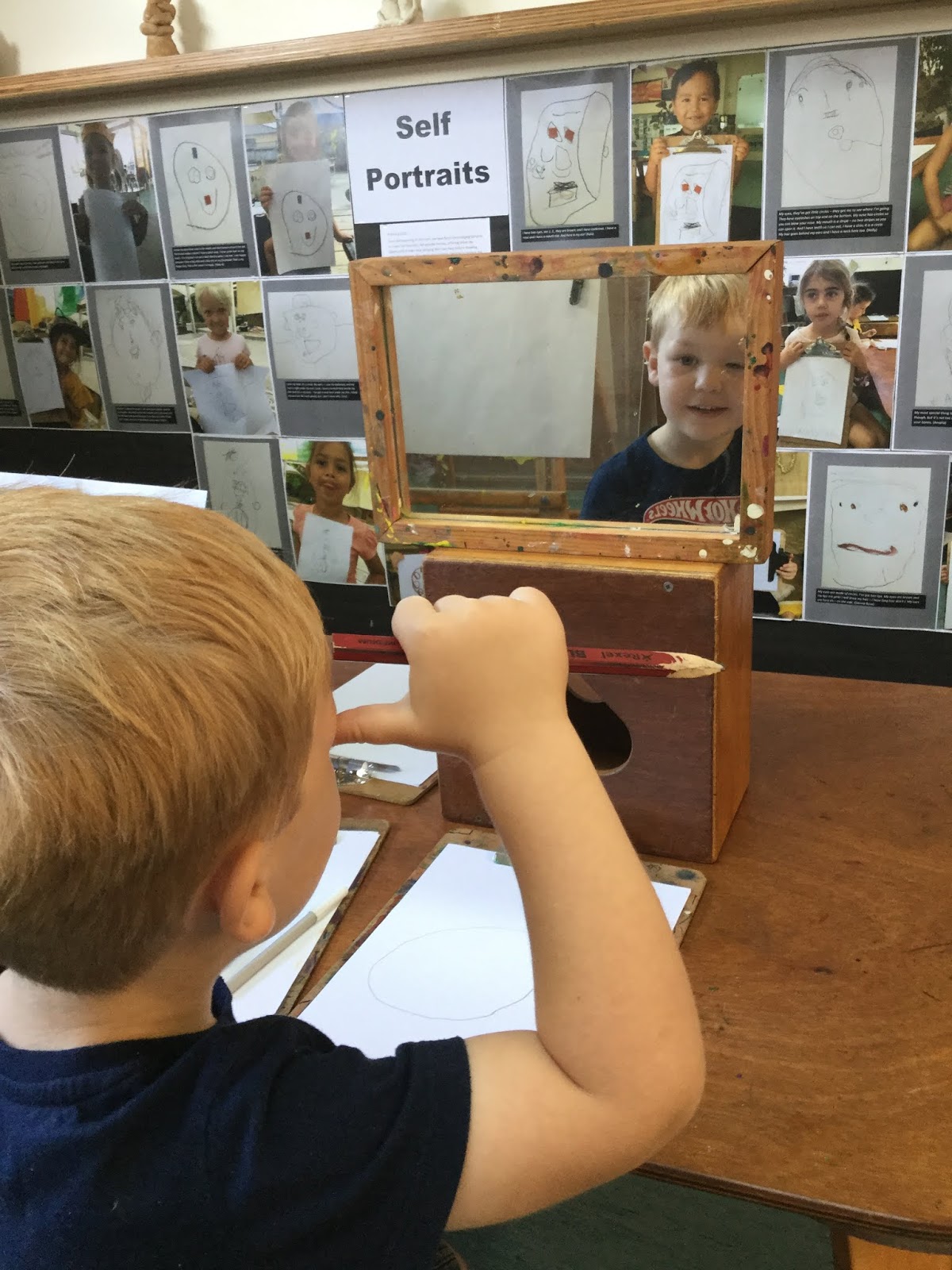
Since the beginning of term one, we have been encouraging our tamariki to explore the creation of their self-portrait. Saenz-Molina (2016) explains; self-portraiture is deeply connected to children’s sense of identity. As they study their features and construct an image of themselves, they are expressing themselves as both the subject and the creator of their art work.

Setting up an art space both inside and outside; we provided mirrors enabling tamariki to take time studying the shapes within their own faces, before drawing what they observed. 


This observation inspires exploration of the form and structure of their features and how they fit together, building their knowledge of basic shapes. 


Translating this understanding onto paper strengthens fine motor control, supporting future literacy skill development. Over time, crayons, paint, wool, coloured felt and glue were added to the available resources, enabling tamariki to explore and depict more details, such as hair and eye colours.

Many of our tamariki have been drawn to this activity, either enjoying a solitary study or in the company of peers, conversing, comparing and collaborating.


Some have later returned to revisit and develop their ideas and images. It has been lovely to observe their enthusiasm, and the detailed observations they have drawn as they progressed their understandings of themselves.

I have missing hair. My nose is missing. I am missing the sunnies on my head. I think that’s all I am missing (Portrait 1)
These (indicating nostrils) are where we put our stuff in to blow our nose. My hair is a bit orangey brownie blackie – it’s all different colours; and I’ve got ears and teeth. My eyes are blue and I have eyebrows. My hair is special, because my favourite thing is to brush my hair (Portrait 2)

As each child has created their self-portrait, I have asked “What do you notice?” and “What makes your face special?” The responses they have given offer an insight into what they understand to be important, and what they value about themselves. In this way, the act of creating and contemplating a self-portrait supported them in communicating their developing sense of themself as a unique individual, promoting their sense of wellbeing.

My eyes, they’ve got little circles – they get me to see where I’m going. They have eyelashes on top and on the bottom. My nose has circles so you can blow your nose. My mouth is a stripe – no two stripes so you can open it. And I have teeth so I can eat. I have a chin; it is a circle. My hair goes behind my ears and I have a neck here too


My ears – Oh I missed it! (Pointing to R ear then re-drawing it) I have a hat and my hair here. My eyes are circle. I see my nose and it has holes. My mouth has teeth here, that’s too tricky – and I have a tongue in my mouth.

I have two eyes, see 1, 2., they are brown; and I have eyebrows. I have a nose and I have a mouth too. And here is my ear!


I saw my hat. This scribble is the scribbling on my hat like here (showing me his hat) The lines are my hair. These are my cheeks and I have a tiny ear and a big one. This is the sand on my head here, and on my nose. The white paper is my sunblock, except this white paper here is the white in my eyes. These here are the ninja turtles on my T shirt and the squares they are inside. 

My most special thing is my smile. I don’t know why it is special though, but it’s not too strong and it won’t hurt you and break your bones.

I saw my head. It’s a circle. My eyes – I saw my eyebrows, and my nose is right under my eyes. Look, I have a scratch here beside my chin and this is my neck – I’ve got a neck here under my chin. I think my eyes are the most special, but I don’t know why.


For a small number, their exploration has extended further, as they considered their form in different perspectives and dimensions. Discovering the concept of profile has involved investigating different shapes and placement of features, while clay provided a way to depict facial features in three dimensions.


ICS learning centre (2013), explain drawing enables children to share experiences and thoughts, imagine and explore ideas, focus and concentrate, and that observational drawing is a part of meaningful and authentic early childhood art education. Children’s engagement with drawing strengthens memory and spatial understanding. Observational drawing encourages looking closely at details, to find out more about the subject of their drawing, and assists children’s ability to: -
Communicate what they see, and expressing what they interpret as the important features within that
Make decisions about what to emphasize and include in their work.
Become confident in attempting something new.

It has been lovely to observe the evident interest and focus of the tamariki as they have engaged with self-portraiture. The development in their skills, and expression of their working theories as they explored their sense of self was amazing. Working theories are the evolving ideas and understandings that children develop as they use their existing knowledge to try to make sense of new experiences Children are most likely to generate and refine working theories in learning environments where uncertainty is valued, enquiry is modelled, and making meaning is the goal. (Te Whāriki, 2017)


Ma te wa,
Anne


Monday, 24 February 2020

How can tree climbing be valuable learning?


Last year we were asked to support Sue Stovers with her presentation ‘climbing trees’ at the NKA conference.  This opportunity got me thinking, how can tree climbing be valuable learning for our tamariki?  How do we challenge our children to reach their ‘risk taking’ goals?  And does it actually help children to build resilience in our kindergarten environment?


“To climb a tree is for a child to discover a new world”.  (Friedrich Frobel)


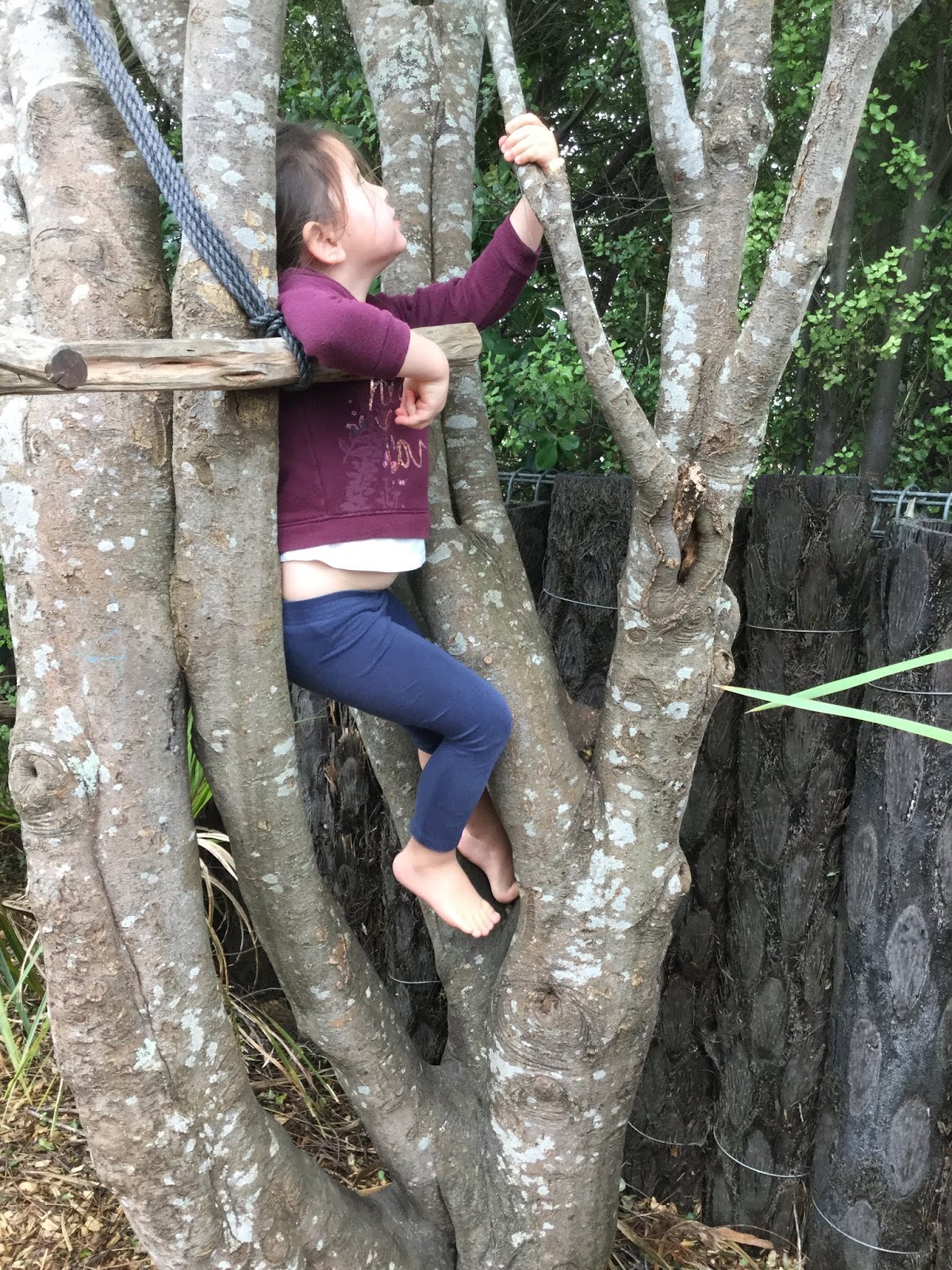
At Mairtown kindergarten we are all for children taking responsible risks within their learning.  Risk taking can be viewed in many different ways and forms, and climbing trees is one way we promote it.  We believe it is highly important to have a risk rich environment, this is underpinned through our image of the child, that they are capable, confident and competent lifelong learners. Our environment promotes a nature based curriculum and we are fortunate to have trees of varying sizes for our tamariki to explore and learn to climb.  We also have our monkey bars attached to our big trees, this is an excellent starting place to gain physical strength and confidence to climb.   

“Daily small manageable risks add up to big gains in a child’s self-esteem and self-confidence over time”.  (Nell Regan, 2018)


The teaching team all value the importance of children learning how to climb trees for themselves.  There is no way to rush the process, it takes time for children to develop their muscles and build up their physical strength and confidence, to gain the knowledge that they are strong enough to achieve their goals.  We are lucky to have many wonderful rangatiratanga who can lead by example and role model how to climb.  It is crucial for children to learn how to get themselves up the tree by them self and then they will instinctively know how to get back down again.


“Raise them with an inch of caution, a mile of freedom, and a bucketful of strength.  Children need our courage, not our fear”.  (N. Ryan)


There is no doubt that tree climbing can be both dangerous and safe.  I know for some adults the thought of children climbing high up in trees is terrifying, however, for me seeing children running on the concrete is far more concerning, I would rather see them up a tree.  To children, a climbable tree is a provocation, a challenge, something to conquer.  I believe that the adult’s attitude and/or fears towards tree climbing can have a huge impact towards the learning being successful or negative.  I have always loved nature and grew up climbing trees from a young age, mainly because I really wanted to get up into our tree hut where my older brother and sister were playing. 


I highly value the importance of trees and I think it is great how much valuable learning develops through learning to climb trees.  I believe it is important for children to learn to trust their own gut instinct and understand their own limits to navigate climbing trees. 


“Taking risks in play is essential for children’s growth and development.  Risky play can help children learn their strengths and weaknesses and become more aware of their limitations so that they can learn to take care of themselves".  (Nell Regan, 2018).

It is interesting to observe children learning to climb trees.  It is like they instinctively know how high to climb; finding that point where they feel safe as they learn their own limitations, about their bodies and perseverance.  This is all valuable learning and wonderful life long skills, which children will use widely throughout their life and educational journey.  I love that climbing trees is so beneficial for all tamariki, not only physically but also emotionally.  I also feel it is important to respect children’s goals, whether we think they are big or not.  Sometimes it takes lots of little goals to achieve the big goal.


Research states that “Tree climbing is a risky play activity that has many benefits for the developing child. Kids love the challenge of climbing trees. The physical challenge creates a boost to a child’s self-esteem and the feeling of accomplishment.  There is also a mental challenge to climbing trees. Focusing on “solving the problem” of how to get up the tree creates a resilient “I can do it” attitude when faced with both mental and physical problems in the future.  Some researchers in Florida have measured the cognitive benefits of risky activities like tree climbing.  They found that using your mind to navigate through the tree and operate your hands and muscles while climbing has a tremendously beneficial effect on your cognitive abilities. The improvement in working memory is one of the skills they measured to have marked improvement”. (Nell Regan, 2018). 


This term we have had new children join our kindergarten whānau and it has been lovely to see them rise to the challenge of learning to climb trees and tackle the monkey bars.  I believe it is like anything in life, having a positive attitude goes a long way.  As a teacher, I find it rewarding to see our tamariki conquer doing things that may make them feel a little worried, then use the opportunity to assess the risk and take a responsible risk to master the feeling of achievement.  Indeed all valuable learning.


“The more risks you allow your children to make, the better they learn to look after themselves”.  (Roald Dahl)

Mā te wā
Susie

Translate