Haere mai! Welcome to Mairtown Kindergarten's blog.

Nau Mai Haere mai. Welcome to Mairtown Kindergarten's blog.


21 Princes Street, Kensington, Whangarei, New Zealand

Phone: 09 437 2742

Email: mairtown@nka.org.nz

Saturday, 11 April 2020

Lock-down Learning


On Thursday morning, my phone reminded me it was the last day of Term one. Wow, that really got me thinking! What an unprecedented end to our kindergarten term this has been, for us as teachers, for our beautiful tamariki and their whānau, and for our communities, both local and global. The emergence of Covid-19, and our resulting Level 4 lock-down, has challenged us to adapt to a significantly changed framework of daily life, learn to communicate differently with those we work with, socialise with and love, revisit old skills and develop new ones. Everyone, young and old, has experienced uncertainty, anxiety, challenges and opportunities as we faced, entered, and continue to navigate our way through this never-before experience. In the words of our Prime Minister, Jacinda Ardern, “You are not alone. The benefit of what we are doing will be felt into the future. By staying at home, you are breaking the chain”.


For our teaching team, it is really important that our awesome learning community remains connected and strong across our separate bubbles, as we know the benefits and the importance of our shared relationships. This has meant that our teaching role and interactions with each other at Mairtown Kindergarten have taken on a different form, moving us into areas of technology that we are not necessarily confident or familiar with; as within our curriculum we pride ourselves on utilizing our environment and using natural resources, in preference to technology. 
Establishing and contributing to our Kindergarten whānau Facebook page has challenged our team to extend our skills, and our understandings around how to be effective ECE teachers; and it has also proved to be a fabulous way for our tamariki and whānau to remain in daily contact, sharing their experiences and ideas. “Kaiako are the key resource in any ECE service. Their primary responsibility is to facilitate children’s learning and development through thoughtful and intentional pedagogy.” (Ministry of Education, 2017, p. 59).
We have so loved being able to share in the lock-down lives of Mairtown kindergarten, and we felt we would love to acknowledge the amazing learning which we see taking place every day within our community. This blog is a huge shout out to the first and most important teachers in the lives of our tamariki, their whānau, and the wonderful learning experiences they are providing at home!


 Viv Shearsby (2017) states When children have opportunities to play at length, and be involved with others in investigating possibilities and developing hypotheses, they try things out. They have little fear of failure, and through ongoing and recurring experiences they secure brain synapses that form the framework of their learned knowledge. Over time their competence increases, and with this they develop confidence in their capability. Play allows children to be relaxed and work creatively, revisit experiences, solve problems, engage with others and discover an endlessly new world. Part of what makes play such a successful tool for learning is that it requires a freedom. Play is an activity that is full of purpose – and yet purposeless. Play is often seen as something you do when you are having fun or don’t have something ‘better’ to do, and yet at the same time it brings about the most rapid and profound development visible in our lifetimes.


Bongiorno (2018) further explains the learning explored within play, saying Never underestimate the value of play! It supports children’s learning in so many ways, promoting cognitive, language and literacy, physical, social, and emotional development.


Play is healthy, and reduces stress
Play helps children grow emotionally, as well as helping them grow strong and healthy. It’s active nature is joyful and provides an outlet for anxiety and stress.


If you have a back yard, take the play outside. Humans evolved in nature and research around the world shows very clearly that all of our physiological stress indicators calm down when we are outside in nature (Pennie Brownlee, 2020).


Play outside and inside offer different opportunities but equally valuable learning
Think about the value of your own childhood experiences, and make sure your children create these memories, too.


For children it is crucial that they are the heroes and sheros in their own story, in the real three dimensional world, with their imagination, bodies, and souls. This is true at any time but especially now when many choices for independent action have been taken away, and along with that, their sense of having any personal power (Pennie Brownlee, 2020)


Play and learning go hand in hand
Play and learning are not separate activities. Think about them as a science lecture with a lab—play is a child’s lab.


A huge part of our human brain is the result of our ancestors making things with their hands. That urge to make things is alive and well in our kids. When we invite our children to work alongside us in the kitchen, not only do we end up with co-created scones and soup, our children get to feel that they are important players. Their contributions are appreciated and valued as an essential service for our Bubble (Pennie Brownlee, 2020)


Play is a child’s context for learning
Children practice and reinforce their learning in multiple areas during play. Play provides rich learning opportunities and leads to children’s success and growth in self-esteem.


Our children need to be, to do, and to think. It is their active participation in this world that unfolds their intelligences. That’s why making things is so great. It is problem solving in three dimensions with built-in feed-back: either what you are making works or it doesn’t. If it doesn’t you keep going until you come up with ‘workable’ solution. That’s grit in action right there (Pennie Brownlee, 2020).


In a shared interview for Radio New Zealand on 27th March, neuroscience educator Nathan Wallis and parenting mentor Mary Willow said, The kids are gonna remember this for the rest of their lives. It's going to be a memorable thing. So I think it's good for parents to have that in the forefront of their mind and just create wonderful memories. If we can look upon this period as an adventure rather than a jail term we can bridge the children through it and set them up for expanded minds and hearts on the other side, rather than residual anxiety and scars. Your family ship is in new waters. Let the adventure begin!"


We are filled with joy and confidence as we watch from afar, the learning adventures of tamariki within our kindergarten community. The rich and varied learning experiences they are gaining within their whānau bubbles are developing their physical and thinking skills, growing their self-confidence and building positive lifelong memories of this historic time spent in their circle of love.
As the first term ‘officially’ comes to an end, we send our aroha, and best wishes for a safe, healthy and play filled Easter. We are on the right track, and we are looking forward to the time when we are all able to share our lock down tales in person. In the meantime, remain in your bubbles, keep learning and keep sharing!


Nurture and play. These are the two absolutely essential requirements that enable the human brain to unfold into its human potential, the more emotional nurture and play the better. Bringing our playful spirits to any task turns living into an adventure (Pennie Brownlee, 2020).

Be safe, be kind to yourselves and others and Kia Kaha!

Susie, Sarah, Hanna, Anne and Emma 

Friday, 3 April 2020

Our Pepeha


Kia ora,

I hope you are all safe and happy in your bubbles, and while the lock down is an unexpected, and for many a really stressful experience, I hope you are able to enjoy this opportunity to connect as a whānau.

I thought I would take a moment to talk about our centre pepeha, which we have been learning as a group during the past term. Our pepeha was gifted to Mairtown kindergarten by local kaumatua and master carver Te Warahi Heteraka, and you will find it recorded in your child’s portfolio. It has been an honour to receive this gift, and to honour it, we wished to ensure it became a living part of our curriculum which held meaning for all of our tamariki, and not just a piece of paper. In order to do this, we have set the words to music, using the tune of ‘Ma is White’, which is well known by many of our tamariki; and we are so grateful to Kelly (Taikura’s dad) for helping us to add appropriate actions. There is nothing better than words and movement to make words stick in your memory, and bring meaning to them.

Taraporvala (2019) states, Tamariki can be introduced to a simple pepeha to strengthen their own understanding of who they are and where they come from. The Education Hub explains a child’s wairua (spirit or soul) comprises their connectedness to all life, from those who have come before them, to the geographical landmarks of their shared environment and a respect for their natural world.

Our centre pepeha acknowledges that we have come here from many places to share this beautiful kindergarten together, as have those who have been here before us; and that we honour both the amazing environment it sits within, and the Iwi (Tribe) and Hapu (communities/families) who belong to this area and allow us to share it with them.

These are the words of our pepeha, and their translation;

Ko Parihaka te Maunga
Parihaka is the Mountain
Ko Hoteo te Awa    
Hoteo (Hatea) is the River
Ko Ngāpuhi-Nui-Tonu te Iwi
Ngāpuhi-Nui-Tonu is the tribe
Ko Parawhau, ko Ngāti Kahu-ki-Torongare, ngā hapu o Whangārei Te Terenga Paraoa      
        Parawhau, and Ngāti Kahu-ki-Torongare, the communities/family groups of  Whangarei   

                                            Ko Mairtown te wāhi                                          
Mairtown is the place/location
          Ko Mairtown tōku Kura Kohungahunga            
Mairtown is my Kindergarten
                   Anei mātau, nō ngā hau e whā                   
Here we are, from the four winds   
                                        Tihei wā mauri ora!                                         
Behold, there is life!


We are so proud of the way our tamariki have taken ownership of this pepeha, and we have loved sharing the process of learning it and making it a part of ourselves alongside them. I hope they can share it with you too!

Ma te wā,
Anne

Sunday, 22 March 2020

Mairtown Kindergarten Wheel-a-Thon 2020


The excitement has been building at Mairtown Kindergarten over the past few weeks, as we have been counting down to our annual event we have on our kindergarten calendar at whānau time. 


The Mairtown Kindergarten Wheel-a-Thon! 


This has become a important yearly tradition at Mairtown, and is often a fun-filled and busy afternoon shared with our kindergarten community. 
   
For some of our tamariki this will be their second wheel-a-thon and they have been practicing over the holidays they have set themselves the challenge of riding on two wheels!!! 


During morning whānau time, tamariki have been sharing what they were bringing to the wheel-a-thon: 

"I'm bringing my scooter" - Ollie.

" My bike, and I have ribbons on my helmet" - Holly.

" I'm bringing a blue bike, of beau's one" - Tori.

"I have streamers on my bike" - Alistair.

"I'm excited to go to the wheel-a-thon with my nana. I have a butterfly with a dress and a wand" - Finlay.

"I will dress-up as Elsa!" - Hadassah.


Wednesday arrived and what a beautiful day, filled with blue sky's and sunshine!  We were all looking forward for an afternoon of great fun, you could feel the definite eagerness and enthusiasm in the air at kindergarten as the excitement started to build during the day.

Capped super-heroes,  princesses, unicorns, masked spider men, butterfly's, flower gardens, so many carefully and beautifully decorated bikes and tamariki, excitedly arrived on all sorts of wheels at the Kensington Netball courts. 


Tamariki all lined up and ready to go as we celebrated our annual kindergarten wheel-a-thon fundraiser.  This is always such a big and enjoyable family event and is well attended by a large number of our amazing kindergarten community.


We are so lucky at Mairtown Kindergarten to have a community that supports our fundraising events for the Kindergarten.  We appreciate the time taken to organise busy afternoons to come to these events. 

"Relationships are the heart of the community. And a sense of being connected to the community through relationships is at the core of the good life. In fact, the community provides endless opportunities for the creation of relationships" (Imagine Better, 2020).
  

Also big THANK YOU to the Guy Telfer Transport and the Multi Kai cookers (Andrews whānau) who donated, koha towards covering the costs for this event.  This insured that 100% of monies raised is able to come back to Mairtown Kindergarten for new fans for our kai eating area. 


Wheel a thon 2020


Once again, thank you to our kindergarten community and whānau
 for all their wonderful support! 

Nga mihi nui

Sarah


Tuesday, 17 March 2020

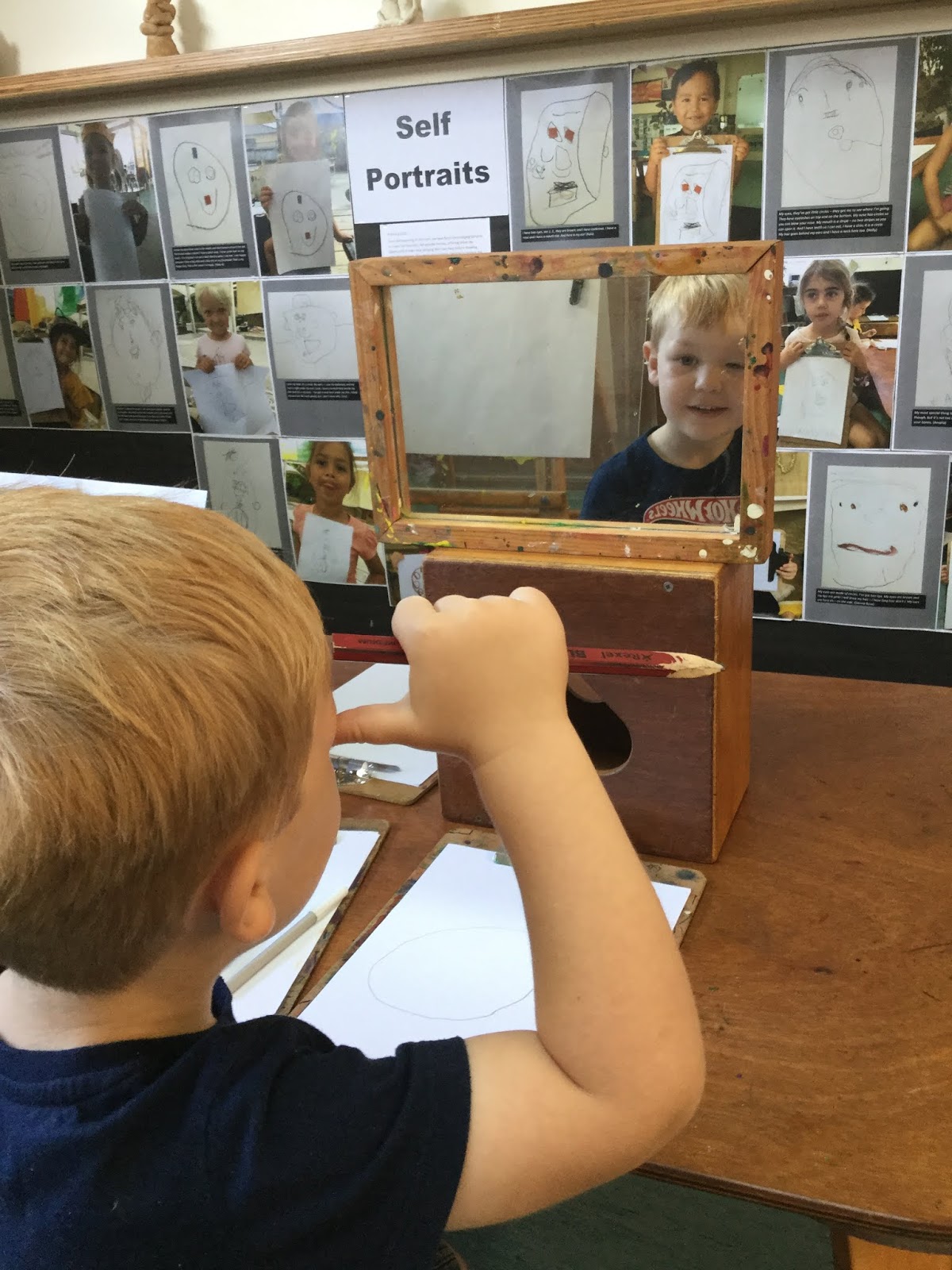
Self Portraits


Since the beginning of term one, we have been encouraging our tamariki to explore the creation of their self-portrait. Saenz-Molina (2016) explains; self-portraiture is deeply connected to children’s sense of identity. As they study their features and construct an image of themselves, they are expressing themselves as both the subject and the creator of their art work.

Setting up an art space both inside and outside; we provided mirrors enabling tamariki to take time studying the shapes within their own faces, before drawing what they observed. 


This observation inspires exploration of the form and structure of their features and how they fit together, building their knowledge of basic shapes. 


Translating this understanding onto paper strengthens fine motor control, supporting future literacy skill development. Over time, crayons, paint, wool, coloured felt and glue were added to the available resources, enabling tamariki to explore and depict more details, such as hair and eye colours.

Many of our tamariki have been drawn to this activity, either enjoying a solitary study or in the company of peers, conversing, comparing and collaborating.


Some have later returned to revisit and develop their ideas and images. It has been lovely to observe their enthusiasm, and the detailed observations they have drawn as they progressed their understandings of themselves.

I have missing hair. My nose is missing. I am missing the sunnies on my head. I think that’s all I am missing (Portrait 1)
These (indicating nostrils) are where we put our stuff in to blow our nose. My hair is a bit orangey brownie blackie – it’s all different colours; and I’ve got ears and teeth. My eyes are blue and I have eyebrows. My hair is special, because my favourite thing is to brush my hair (Portrait 2)

As each child has created their self-portrait, I have asked “What do you notice?” and “What makes your face special?” The responses they have given offer an insight into what they understand to be important, and what they value about themselves. In this way, the act of creating and contemplating a self-portrait supported them in communicating their developing sense of themself as a unique individual, promoting their sense of wellbeing.

My eyes, they’ve got little circles – they get me to see where I’m going. They have eyelashes on top and on the bottom. My nose has circles so you can blow your nose. My mouth is a stripe – no two stripes so you can open it. And I have teeth so I can eat. I have a chin; it is a circle. My hair goes behind my ears and I have a neck here too


My ears – Oh I missed it! (Pointing to R ear then re-drawing it) I have a hat and my hair here. My eyes are circle. I see my nose and it has holes. My mouth has teeth here, that’s too tricky – and I have a tongue in my mouth.

I have two eyes, see 1, 2., they are brown; and I have eyebrows. I have a nose and I have a mouth too. And here is my ear!


I saw my hat. This scribble is the scribbling on my hat like here (showing me his hat) The lines are my hair. These are my cheeks and I have a tiny ear and a big one. This is the sand on my head here, and on my nose. The white paper is my sunblock, except this white paper here is the white in my eyes. These here are the ninja turtles on my T shirt and the squares they are inside. 

My most special thing is my smile. I don’t know why it is special though, but it’s not too strong and it won’t hurt you and break your bones.

I saw my head. It’s a circle. My eyes – I saw my eyebrows, and my nose is right under my eyes. Look, I have a scratch here beside my chin and this is my neck – I’ve got a neck here under my chin. I think my eyes are the most special, but I don’t know why.


For a small number, their exploration has extended further, as they considered their form in different perspectives and dimensions. Discovering the concept of profile has involved investigating different shapes and placement of features, while clay provided a way to depict facial features in three dimensions.


ICS learning centre (2013), explain drawing enables children to share experiences and thoughts, imagine and explore ideas, focus and concentrate, and that observational drawing is a part of meaningful and authentic early childhood art education. Children’s engagement with drawing strengthens memory and spatial understanding. Observational drawing encourages looking closely at details, to find out more about the subject of their drawing, and assists children’s ability to: -
Communicate what they see, and expressing what they interpret as the important features within that
Make decisions about what to emphasize and include in their work.
Become confident in attempting something new.

It has been lovely to observe the evident interest and focus of the tamariki as they have engaged with self-portraiture. The development in their skills, and expression of their working theories as they explored their sense of self was amazing. Working theories are the evolving ideas and understandings that children develop as they use their existing knowledge to try to make sense of new experiences Children are most likely to generate and refine working theories in learning environments where uncertainty is valued, enquiry is modelled, and making meaning is the goal. (Te Whāriki, 2017)


Ma te wa,
Anne


Translate