Haere mai! Welcome to Mairtown Kindergarten's blog.

Nau Mai Haere mai. Welcome to Mairtown Kindergarten's blog.


21 Princes Street, Kensington, Whangarei, New Zealand

Phone: 09 437 2742

Email: mairtown@nka.org.nz

Sunday, 4 October 2020

Celebrating Language and Culture


An ongoing goal held by our teaching team, is to ensure the knowledge and cultures of each of our beautiful tamariki can shine through, being seen, heard and honoured within our Kindergarten environment. Over the last term, we have been privileged as a kindergarten to celebrate both Uike Kātoanga’i ʻo e Lea Faka-Tonga/Tongan language week, and Te Wiki o te Reo Māori/Māori Language Week.

Underpinning our national curriculum document, Te Whāriki (2017), is the vision that children are

Competent and confident learners and communicators, healthy in mind, body and spirit, secure in their sense of belonging and in the knowledge that they make a valued contribution to society.

This vision implies a society that recognises Māori as tangata whenua and assumes a shared obligation for protecting Māori language and culture. New Zealand children are growing up in a society that comprises people from a wide variety of cultures and ethnicities. Te Whāriki acknowledges the educational aspirations of Pasifika peoples, and as kaiako we work in partnership with whānau, family and ‘aiga from all backgrounds to support tamariki in growing up strong in their individual identity, language and culture.

2020 marks the first time we have recognised Tongan Language Week within Mairtown curriculum, and we were proud to be able to make links with the funds of knowledge held within our Tongan whānau and finding authentic ways to celebrate Tongan language and culture within our daily curriculum. This honours values we express in our centre philosophy Inherent in our practice is our focus on being welcoming and inclusive of the diversity of all our children and whānau. We love to acknowledge and celebrate cultural diversity within our community, and value the opportunities that enable us to learn about different people, their beliefs and way of life.

In the paper Culturally responsive pedagogy in ECE, prepared for The Education Hub, Dr Vicki Hargraves states, Culturally responsive approaches emerge from an understanding of families’ backgrounds that connects families’ cultural heritages to the setting and effects more equitable opportunities for both children and families. Children’s cultural backgrounds are drawn on to determine teaching approaches, selection of materials and environments, and interactions with children and their families. Given that early childhood education experiences are the first experiences that children have of education outside the home, curricula and values that empower children’s identity and values, and uphold their rights, are of paramount importance.

We were so grateful to Maci and Paulie’s Auntie, who shared with us the finger play song ‘Mālō e lelei’, which introduces useful Tongan greeting phrases. We practised this at whānau time each day and the tamariki became very involved in learning the song, singing out clearly and strongly by weeks end. They appeared to enjoy interacting with the Tongan language, and the familiar tune and actions used in the ‘Where is Thumbkin’ finger game helped support their learning. In a similar way, we sang the Ma is white song but using the Tongan names for the colours, and again the familiar structure involved the tamariki quickly in using the initially unfamiliar words.


Our Pukapuka o te Wiki was the traditional Tongan story “The Mouse and the Octopus”, by Lisala Halapua. This story was traditionally used when teaching children the art of catching an octopus using a lure. The book was humorous, as the mouse plays a trick on the helpful octopus, and a steady number of tamariki chose to engage with it each day.


In our art area, we provided examples of Tongan Ngatu, or Tapa cloth designs. These engaged tamariki with their clear outlines and colour fill, and the methodology again had similarities with other art provocations and methodology we have used e.g. Hundertwasser. This built on the confidence and competence of the tamariki, while offering them a new perspective and insight into the Tongan culture.


During whānau time Tamariki engaged in discussion of the geographical location of Tonga and the annual migration of the Humpback whales from Antarctica.


What was particularly interesting was while on Monday none of our tamariki volunteered during group discussion that they were of Tongan identity, as the week passed there was increased sharing of their own experience of the culture, especially by one tamaiti. “This song came from my Auntie” “I have family who speak Tongan all the time at home”. It was very rewarding to see the ownership and pride in having this unique and special identity developing.

Hoko pe fai mo e fau – Joining together the hibiscus cord with hibiscus cord

To connect two strong characters or people, then they will be successful

Critical multiculturalism encourages teachers to assess and support children holistically through exploring and developing an understanding of the child's cultural background. Through working in partnerships with parents and supporting their cultural background teachers are able to support children in their sense of worth and belonging which promotes their overall well-being. One of Te Whāriki’s goals is for children to develop a sense of identity and belonging within their early childhood centre, as a positive identity and sense of belonging are an essential part of learning (Hargraves, 2020).


Māori Language Week came the following week, offering us a chance to celebrate something truly unique to Aotearoa New Zealand.
While you may not be a fluent Māori speaker, (or even want to be), the Māori language is still a part of who we are as a nation. (kiwifamilies.co.nz)

This year’s theme was 'Kia kaha te reo Māori’ — ‘Let’s make the Māori language strong'.

Strength for an endangered language comes from its status, people being aware of how to support revitalisation, people acquiring and using it and from the language having the right words and terms to be used well for any purpose.
— Te Taura Whiri i Te Reo Māori (Māori Language Commission)

This was a busy and emotional week for our kindergarten whānau, including within it the sadness of Susie’s last day with us, and the welcome return of Zair while Susie’s replacement is found.

Te wiki o te reo Māori provided a wonderful reminder to us as kaiako to remain naturally connected with all aspects of Te reo me nga tikanga Māori within our curriculum, practice and relationships.

Following our favoured approach of building on the existing understandings and funds of knowledge of our tamariki in order to support their identities as tamariki of the bicultural nation of Aotearoa, we followed the familiar pattern of working within the understood framework of our daily curriculum.

We shared the pūrakau ‘In the Beginning’ by Peter Gossage as Pukapuka o te Wiki. This pūrakau, describing the separation of Papatūānuku and Ranginui and introducing the Atua, their children, and their respective roles as kaitiaki of our world, is a favourite with our tamariki.


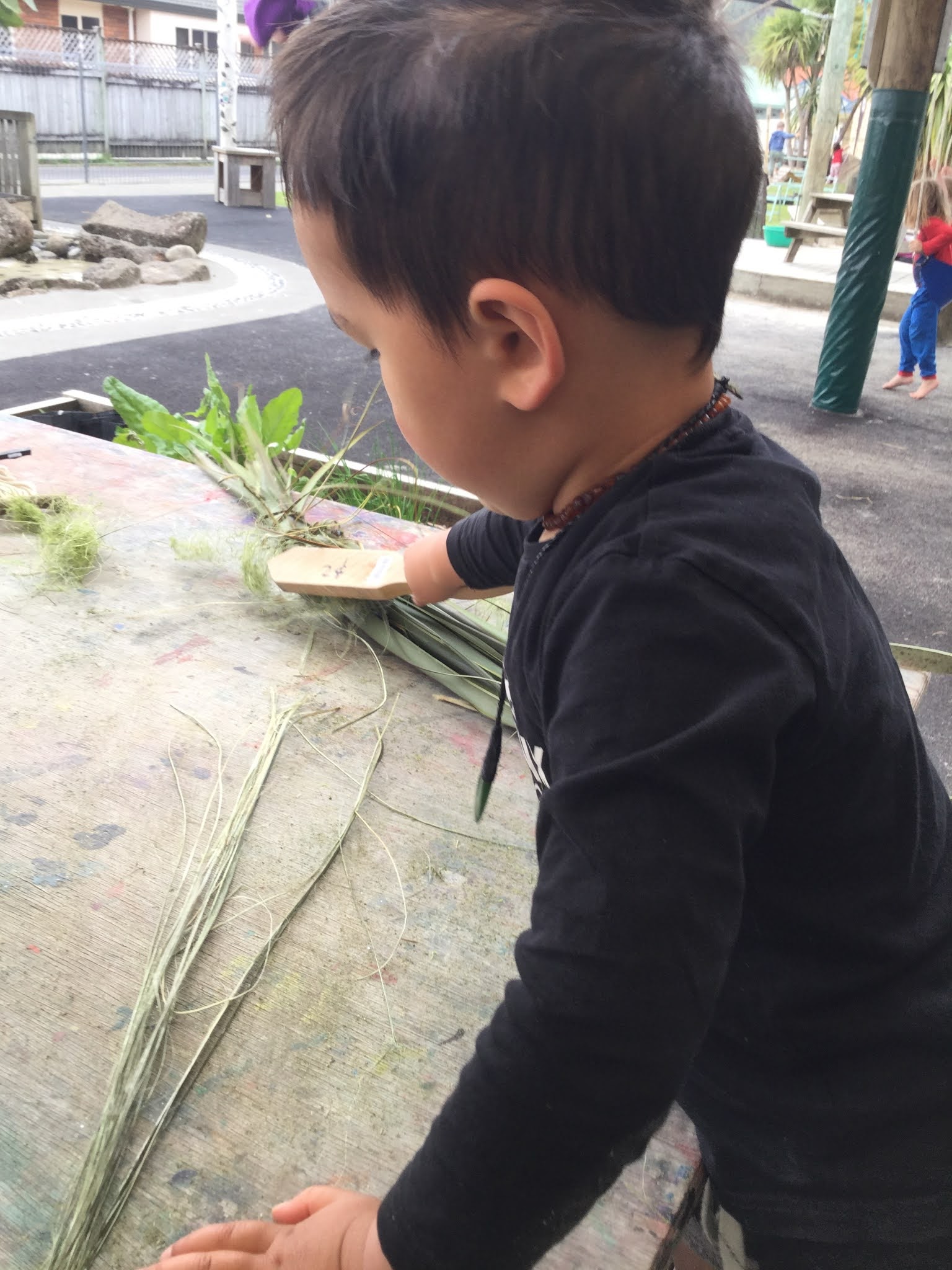
Sarah worked with the tamariki to create a Kākahu by working with harakeke to form moka, which was bound into a garment and then gifted to Susie, carrying our aroha and manaakitanga with her on her journey of healing following her surgery. In this experience, tamariki engaged with not only the technical skills, but also the traditional use of a valuable resource and the tikanga inherent within that.


Following on from our Ngatu art, tamariki then had the opportunity to explore traditional Māori designs within their art, and moved on to expressing both of these on pieces of wood, which we look forward to proudly displaying in our environment.


At whānau time, tamariki enjoyed singing’ Hoea te waka’, and ‘Ma is white’ – a song we can now explore using three of the languages within our kindergarten whānau. Perhaps this is something we can continue to build on further!


In the paper Culturally responsive pedagogy in ECE, prepared for The Education Hub, Dr Vicki Hargraves states, Culturally responsive approaches emerge from an understanding of families’ backgrounds that connects families’ cultural heritages to the setting and effects more equitable opportunities for both children and families. Children’s cultural backgrounds are drawn on to determine teaching approaches, selection of materials and environments, and interactions with children and their families. Given that early childhood education experiences are the first experiences that children have of education outside the home, curricula and values that empower children’s identity and values, and uphold their rights, are of paramount importance.

We are so proud of the inclusive way that the tamariki of our whānau explore and embrace the cultures and understandings which form our special Mairtown kindergarten whānau. These two weeks have shown us yet again just what amazing learners our tamariki are, and also serve to remind us of the richness which is within our community and the value to be gained from sharing our knowledge. We would love to continue learning more about the cultures of the individual whānau within our community.

Ko te pae tawhiti whāia kia tata, ko te pae tata whakamaua kia tīna!
Seek out the distant horizons, while cherishing those achievements at hand!

Mā te Wā

Anne

Monday, 21 September 2020

Susie's Farewell


Kia hora te marino, kia whakapapa pounamu te moana, kia tere te kaarohirohi a, ko tou hoa haere, ko te rangimarie.

May the calm be widespread, may the ocean glisten like greenstone, may the shimmer of light dance across your pathway and may peace itself be your travelling companion.


Last Tuesday we sadly said farewell to Mairtown Kindergarten’s Head Teacher Susie.  Susie has been part of the Mairtown Kindergarten teaching team for the past 7 years and she will be greatly missed.  Susie has chosen to resign at this time to enable her to focus on her recovery, as she undergoes more surgery on her elbow.


As most of you know Susie has been a dedicated teacher to the tamariki at Mairtown Kindergarten and a wonderful leader to the teaching team.  Susie is gentle in nature as she is in heart, and we will miss her wonderful wairua and beautiful smile.  We know that this was not an easy choice for Susie to make, but an important one; ensuring that her recovery goes smoothly and is unhurried. This will allow Susie to achieve the best possible outcome in terms of returning her arm to its full function.

We often talk about the importance of the well-being and health of our tamariki. It is also important for educators to be able to acknowledge that this is just as important for ourselves. 

“Teaching is a challenging profession. It stretches us as people – physically, mentally, socially and spiritually. Teaching can test our professional ability at times and sometimes even test the very strength of our hearts and minds.” (Teaching Council New Zealand).


Susie requested a low key, no fuss event for her farewell – but if you know the Mairtown Teaching Team and our Mairtown Whānau, that is a difficult thing to do!  We organised a “Super Day” for the tamariki as a celebration of Susie’s time with us. Susie’s farewell coincided with Te Reo o Te wiki Māori, so for their parting gift the tamariki made Susie a Kākahu – under the guise it would take at least a week to complete. On Monday Tamariki energetically scraped muka from the harakeke to add to the Kākahu. 


On Tuesday, which was Susies last day, tamariki proudly formed the rainbow tunnel as we sent Susie off in our Mairtown farewell ritual.  She was presented with her farewell gifts,  and her Kākahu, not quite complete as during her last day each tamariki selected a feather to be woven into the Kākahu; each adding their personal touch to her farewell gift. The completed gift was then presented to her again at the end of the day.


Susie, it has been both a wonderful pleasure and a privilege to have you at Mairtown Kindergarten You have been an important part of our community and you are going to be greatly missed by us all.  We wish you well on your recovery, look forward to updates on your progress and hope to be seeing you again soon!


Ngā mihi nui
Sarah 


Sunday, 9 August 2020

Matariki Hangi 2020


Matariki signals the Māori New Year.  It is a time of renewal and celebration in New Zealand the begins with the rising of the Matariki star cluster.

At Mairtown Kindergarten we started our Matariki celebrations with our Harvest Table.  Where whānau were able to share their abundance of what they had a home and in their gardens, alongside heartfelt and positive affirmations for the receiver. 


To conclude our Matariki Celebrations, we have one of the most anticipated events at Mairtown Kindergarten.  Our hangi, and lantern walk.  Lots of excitement and preparations that happen in the weeks leading up to this wonderful event.  Since Term 2, tamariki have been creating a beautiful art piece that are now a show case at the kindergarten, these were hung in our outdoor deck area on evening of our hangi.  Carefully over a period of weeks the tamariki created Atua from the book “In the Beginning” By Peter Gossage based on the creation story. Tamariki hand painted their Atua onto wood donated from our whānau and now proudly hang for all our community to view.


Alongside this there has lots of practicing of “This little light of mine”. 


Whānau provided amazing amounts of Kumara, Potatoes, Pumpkin and Cabbages for the hangi and banana leaves to line the baskets.


On the day of the hangi, it is all go from 8.30am.  Whānau come in and help with the preparations for the hangi.  Fondly called “The Great Peel”, there is always a flurry of activity and as a teaching team we are always humbled and grateful for the support.   


Paraoa parai (Golden puffs of deliciousness - fried bread) is made in the kitchen and fill’s the kindergarten with wonderful smells!


“Matariki hunga, Matariki ahunga nui”
“Matariki has many admirers, Matariki brings us together”    


The kindergarten is transformed and prepared for our whānau to return in the early evening. 


It is wonderful to watch as all our whānau come together with their tamariki. This event is open to all our whānau and their extended whānau so this is an exciting time for tamariki to share their space with all their whānau.

Once again Kelly illuminated our environment with his musical skills.


Once the process of lifting of the hangi and blessing of the kai was complete, it was time to come together and enjoy our meal together, followed by beautiful desserts prepared by our whānau.  Roasting of marshmallows on the fire and our lantern walk outside of the kindergarten concluded the lovely evening for us all.


The Mairtown teaching team, would love to thank all our wonderful whānau who koha vegetables, prepare the stuffing, cooking of the bread, sourcing banana leaves and especially taking their time to awhi us all in making this another successful event! Also to Kelly and Wiremu for once again sharing your musical talents.  All through the night whānau shared with us their appreciation of feeling such a wonderful sense of whānaungatanga .  Without our amazing whānau community these events would not be as successful and we love to be able to send our appreciation for you all.

"Children’s funds of knowledge are learnt in their whānau, communities and cultures and are brought to their early childhood setting. Funds of knowledge are gained through whānau, community and cultural practices and events, where children learn informally through observation and participation." (Ministry of Education)


Special thank you to Finlay and Mason’s whānau Gayla and Doug Andrews, who over the years have donated their Multi-kai hangi cookers for us to use.  This year they organised for us to borrow one from Alfie’s Split roast, thank you to Alf and Kayla who kindly lent us their multi-kai cooker!


Tamariki voices:

What did you most enjoy about our Matariki Hangi?

Theo - When we singed.
William - My favourite part was when we had the food.
Louis - Marshmallows!
Izzy - The chicken.
Kaia - Apples.
Owen - I saw the stars.
Taikura - Cracking the pumpkins.
Paul - Eating the pumpkins!
Finlay - The marshmallows and the food

https://youtu.be/KZ30fEg-cX8

Ngā mihi maioha.


Sarah

Translate