Back in April 2022, I learnt of a water sampling
programme which was being undertaken by Wai Tuwhera o te Taio (Open Waters
Aotearoa), part of the Environmental Authority. Their programme involves linking community
groups and the science of Wilderlab, to sample and undertake testing of the water within our
rivers, lakes, estuaries and wetlands. The aim of this programme is to enable
local communities to understand
their own waterways better, and use the knowledge gained to consider how we can
contribute to improving the health and diversity of life within them over time. The testing involves analysing, discovering and identifying the
environmental DNA (eDNA) filtered from the sampled water, and informing us about what this information tells us about the health of our water.
In their
words…Environmental DNA, or eDNA, refers to all the tiny traces of genetic
material that is left behind as living things pass through water or soil.
In your
backyard, local stream or boggy field lurks a secret web of co-conspirators.
Largely unseen, they slink and swoosh, creep and crawl, helping each other to
survive. Sometimes there are many, sometimes there are few. How do we know
this? They leave their DNA behind.
From
kērēru to kōwhai, and the leaves in the wind, all living things shed genetic
information into their local environment. This is called environmental DNA, or
eDNA.
For
example, a bird flies over a lake and drops a feather. Under the surface, a
fish swims around and, if it is unlucky, gets gobbled up by bigger fish.
Likewise, an insect may fall into the lake, and leaves fall from trees. These
plants and animals leave behind ‘genetic breadcrumbs’ (such as skin cells and
faeces) in the environments they live in.
“In one drop
of water are found all the secrets of the ocean” Kahlil Gibran
Our Mairtown
Kindergarten Nature Programme group have a special connection with the
beautiful ngahere of Mair Park, where we spend our Friday mornings. One of
our favourite spots to spend time is “The Beach”, at the rocky edge of the awa
Hoteo as it passes the foot of Parihaka maunga. I felt that participating in
this sampling programme would be a great way for us to learn more about our awa
and the life which surrounds us there. Gaining knowledge helps us think about how we can support the environment which in turn sustains us.
Vegetation helps maintain the
equilibrium of the atmosphere, taking up carbon and releasing oxygen, and
pumping water from the earth to the sky. Soil is the thin mantle which overlays
rocks, retaining water and nutrients. It supports vegetation and thus all other
life that feeds on plants or animals. Fresh water, essential for terrestrial
and aquatic life, is replenished and cleansed through the water cycle. These
elements and their interactions make up the biosphere and keep us all alive.
We need to be careful our actions do not
disrupt the balance of the atmosphere, oceans, water and land. While growing
populations create pressure on the earth’s resources, it is really how we live
our lives that makes the biggest difference to the planet. (Enviroschools).
So, I put in an application
to participate in the autumn testing, but we missed out on that round. They
encouraged us to reapply, though, so I tried again for the Spring Summer
testing round of 2022/23. That time we were successful, so it was time to start
getting prepared!
They sent us out a testing
kit, and I watched webinars to learn about the process. I contacted Matua
Winiwini Kingi, of Ngatai Kahu o Torongare, and he agreed to accompany us and
bless the eDNA sample as it left our awa and headed off on its journey to the
lab. We made plans to take our sample in early December.
At whānau time in November, I
explained to the tamariki what we would be doing, and what we might learn. We
talked about how the water in our awa travels from its beginnings, both from Kamo down the awa Waitawa, and Glenbervie along the awa Mangakino, then down the Hoteo/Hatea awa on its journey to the sea, collecting ‘memories’ of the life it
interacts with on the way.
They then shared their thoughts about what lifeforms
they thought we would discover were living within, alongside and above our awa,
and we wrote our own reference list to later compare the results from sample with.Investigations enable
children to extend and expand their learning and thinking, building confidence in learning how to learn. They also enable teachers to gift children
some very important dispositions such as being researchers, by feeding their
curiosity and taking their curiosity further. Investigative approaches enable
children to achieve an impressive depth of learning, and to tackle complex
concepts and questions. Hargraves, 29
And then….THE WEATHER!!!!
Northland skies turned on the taps, and as high rainfall and fast flowing
waters disrupt the quality of the sample, we had to postpone…and then it was the
summer break. Then before we could reschedule in the new year, cyclone
Gabrielle hit☹. Parihaka maunga
and her surrounds suffered damage which meant we needed to take a break. The
Wai Tuwhera team agreed to extend our time limit, and we waited for a period of
calm weather, and a time which suited Matua Winiwini, to align.
March 31st was
that day! We all gathered at our meeting place and made our introductions,
discussed our ‘rules’ and said our karakia before setting off down the hill to
the ngahere. After morning tea we headed to “the Beach”, and how the landscape
has changed since the storms and the slips! The awa was shallower than before
at this point – so many rocks had slipped down the maunga into the riverbed. This
did give us interesting knowledge to discover though – Matua Winiwini found a small
volcanic rock, maybe a remnant of the volcanic beginnings of Parihaka maunga,
and he explained to the tamariki about how this special type of rock, the best
at retaining heat, was traditionally used by his hapu for cooking their delicious
Hangi.
I then unpacked the testing kit
and talked through the equipment and the process with the tamariki. Then it was
waders on and into the water for me, clambering over the slippery rocks and
doing my best not to drop the important kit!
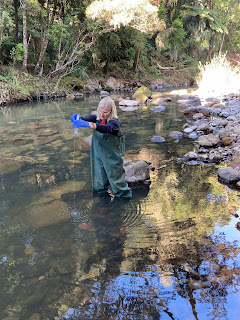


I found a suitable spot and began
the process of filling the 20ml syringe, attaching a special filter, then pushing
the water back out into the awa, leaving its eDNA trapped within the filter.
This process took some time, as a litre of water had to be filtered, and as the
filter progressively filled with material, the task got harder and harder!
Maxwell's Dad and Matua Winiwini helped me out, and the tamariki were very
respectful throughout, of the need to not interact with the water upstream of the sample,
so their play would not disrupt the sampled water with any introduced matter. They watched what
was happening, and played on the water's edge downstream of the sampling, where
they were free to interact with this special environment as they wished. Finally, the sampling was done, and I changed syringes,
adding fixative to the filter to preserve its contacts ready for posting it to Wilderlab.
Then we gathered together as Matua Winiwini shared some words to send our sample on its
journey of knowledge building. Then the whole beach was ours to explore freely again,
and it was time to spend the rest of the morning introducing Matua to our favourite
activities in this beautiful spot – eeling, rock throwing, constructing with
and and whittling the fallen branches😊The eels, water snails and small fish were keen to
come and check out the bacon scraps and peas and corn on offer, so we were
pretty sure their DNA would appear in our sample results too!


The fascinating and wonderful
thing about free play in wild spaces are the resources that assist in the
development of the children, they all are around them and are only limited by
the child’s curiosity and wonder of the natural environments. Cummings, 2010
And then we waited a few weeks,
and at last I had an email telling me our results were in – it was time to
analyse them!! This information would inform us about the life forms which had interacted with the water we sampled, at some point during the last 4-5kms of its journey to 'The Beach', as well as at that point.
I spent some time on the
Wilderlab site, learning about what the findings could tell us. I found our
sample on the interactive map, and I also discovered that a larger set of
samples had also been taken over a 24hr period during the Bioblitz event in
October 2022, reasonably close by. This means we are contributing to a bigger
picture of the health of our awa over time. I discovered that our tamariki had made many correct predictions, although no amnonytes or extinct stuff were found!And the 20 largest eDNA results extracted were of...
although there were many others...an eleven-page sample report of 236 identified life forms including plants, insects, mammals, fish, birds, algae, bacteria, insects worms, molluscs and various single cell and microscopic organisms in fact!
This list contained a couple of surprises, like snapper, who couldn't live in the predominantly freshwater of our awa upstream from 'The Beach' - I think a fisherman has maybe thrown out his waste in the awa after filleting his catch?! And the goldfish and pond weed - maybe an aquarium has been emptied out in the awa, introducing pests into our awa?!
Wilderlab also provided an accompanying ‘Wheel of Life’ image which
places all the lifeforms next to their nearest ‘relatives’, assigning each classification
its own colour.
And we found our tamariki had not done too badly at all with their predictions either!Our awa was given a TICI score (The Taxon-Independent
Community Index) which indicated the overall health of our awa is poor. This is
lower than the average rating gained from the nearby Bioblitz sample last year,
and that concerned me, so I did some more research!
This score reflects a change
in the way living water quality is assessed, which eDNA testing has made
possible. Whereas in the past water quality was determined by the measurement of the nutrient, metal, sediment and acidity levels of the water, now we can assess the presence of
organisms which are sensitive to, or tolerant of, the presence of different
stressors or environmental pressures, including nutrient levels, metal
pollution, temperature or poor habitat. These life forms are called
bioindicators, as their presence or absence indicates the condition of their
environments. 
The challenge now for our
tamariki, is to consider what actions they can promote and enact in the future
to enhance and protect the health and life of our awa for future generations.
Finding ways to create and
live in a healthy and sustainable community is an ongoing learning experience,
and schools and ECE centres are a microcosm of the larger environment. Students
can learn about their world by exploring the diversity of their school/centre
environment and the decisions and behaviours that change it.
If we live within our limits, take only what we need
and design our lives with care for other people and all of nature, we can leave
things in a better state. Drawing on the gifts of our ancestors and the lessons
of our history, we can create a more abundant, diverse, healthy and positive
future. Enviroschools
Here are the links to our results and those of the Bioblitz for your interest!
https://s3.ap-southeast-2.amazonaws.com/wilderlab.openwaters/reports/90dadc66eda71b86.html
https://s3.ap-southeast-2.amazonaws.com/wilderlab.openwaters/reports/29380753129784c2.html
Mā to wā
Anne