Haere mai! Welcome to Mairtown Kindergarten's blog.

Nau Mai Haere mai. Welcome to Mairtown Kindergarten's blog.


21 Princes Street, Kensington, Whangarei, New Zealand

Phone: 09 437 2742

Email: mairtown@nka.org.nz

Tuesday, 21 November 2017

A gift from Tāne Mahuta

Since the beginning of this term, we have had a selection of birds and nests on our central table at kindergarten. The children have enjoyed playing with the birds and listening to each bird’s unique call. From this provocation, we have had many nests arriving at kindergarten, a few hatched eggs that children have been finding at home and even a guinea fowl skull.


Wishing to extend the thinking of the children a little further, I made a trip to the Whangarei Central Library for some New Zealand bird books. When I shared these books with the children on the first day, we simply looked at all the stunning birds that call New Zealand home – noting how big they are, what colour their feathers are, observing any other interesting features and discussing if we had ever seen birds like these when we were out and about.


Because art is a major component of our planning and curriculum, our children at Mairtown are experts when it comes to observational drawing. After a day of simply studying the book and talking, I observed how children were gathering their own resources, picking a picture and beginning to draw what they could see.

Observational drawing is a tool we use a great deal at Mairtown. We see first-hand that when children are drawing an object whilst looking at it in front of them (even when it’s a picture in a book) rather than drawing from memory or imagination, this is when discoveries are made, and when children notice so many new things, often loving to point these findings out and share them with others.


The results of these observational drawings, are very stunning, almost breathtakingly so, yet the learning for the children goes much deeper than the finished product. Observational drawing fosters not only creativity but also cognitive development and creative thinking, it invites children to look very closely at things and to notice all the details. In turn it encourages children to make more intricate drawings than they do from memory alone, often leading to joyful discoveries. It is part of the process of ‘learning to see’ (Kolbe, 2009).


As the days have progressed we have been drawing (lots and lots) and making new discoveries. This is also a way for the children to share what they already know, and perhaps more importantly what they would like to know! I have observed how, as the children have been drawing their birds, how their creative thinking has really blossomed. I was amazed by the questions the children were asking, and then answering, whilst working together in small groups.


I am also reminded about the words of Loris Malaguzzi, founder of the Reggio Emilia approach to education, who felt it was important for the art studio to be subversive; a combination of both art studio and science laboratory. This is certainly evident in the small conversation below I recorded, as the children drew and talked about kiwis. Whilst the children are drawing, you can read how they are able to work through ideas, hypothesise, test theories and answer their own questions. Read this wonderful example of rich conversation as a group of children drew kiwi’s and shared their stories.


Brown Kiwi

Bellbird/Korimako

Ezra: I know about kiwi’s, they live in a forest.
Piper: There are lots of kiwi’s.
Ezra: Yes, some have spots (Ezra is currently drawing a brown kiwi).
Me: The one with spots is called a little spotted kiwi, or a great spotted kiwi. The one without spots has a different name, its name is a brown kiwi.
Ollie (finds the kiwi’s in the book): Hmm, I see they look quite different (he begins to draw a little spotted kiwi) some of him is white.
Ezra: But I can still see brown and a little orange.
Piper: I notice the spots are brown and white, and on its head you get spots.
Ezra: The kiwi has a beak to peck stuff.
Ollie: And to protect themselves Ezra.
Ezra: Yes, to get away from predators!
Kobi (turning to explain this idea to me): That’s so no one can eat them!
Me: What else do we know about kiwi’s?
Max C: They fly.
Ollie: No they don’t fly, see they have no wings.
Ezra: Yes, no wings, I haven’t drawn wings, only feathers!
Ollie: I know they have a good sense of smell.
Me: Why would they need to be able to smell?
Ollie: So they can hear people.
Ezra: They need to be able to smell where the predators are.
Ollie: So they can know what the things are and so they know what they are going to eat.
Kobi: So, they may smell for other animals that like eating kiwi? So they can smell the cat,
when the cat is coming?
Ollie: Yes! Then they might use their beaks to protect themselves. My question is, the reason kiwis have these colours, is when they are next to something the same colour they can’t get eaten. We need to look after them, not kill them.
Me: So the kiwi is camoflauged Ollie?
Kobi: I know that word, it means the same colour.
Ollie: Yes, camoflauged, but we have to hope no one steps on them!


Pied Stilt


When thinking is part of their routine, children become alert to situations that call for thinking (Salmon, 2010)

As we continued to work on our study of New Zealand birds, what happened next, came as a big surprise to everyone (including me!). As the teachers arrived into kindergarten one morning, lying on the step was a dead bird.


Because we had been studying birds for several weeks, but only being able to see the details of them up close through books, I was really keen to share this taonga (treasure) with the children. Children are natural scientists, full of questions and wonder, not at all as squeamish as we adults can be, yet I was still mindful to honour the occasion and role-model respect. Before I shared this beautiful bird, I carefully wrapped it in some fabric and placed it in one of our lovely boxes. We paid tribute to the bird by saying our ‘Mihi ki te Ngahere’ and I talked about the bird being gifted to us from Tāne Mahuta, who in Māori legend is Guardian of the forest, his children being all the birds and trees.


The children all sensed the significance of the occasion and were extremely respectful and very empathetic. They all wanted to hold the bird and stroke it, but showed care, consideration and lots of revere. We looked through our books trying to identify what kind of bird it was, the children took their time to look at each picture (and there were many) and look for similarities and differences. We soon settled on the blackbird page, and from further investigation we were able to conclude that we felt our bird was a young blackbird. As you may imagine, the conversation during this time was plentiful, rich and meaningful, many children wanted to contribute their thoughts and findings. Some of the topics we talked about included how the bird arrived at kindergarten and why we thought Tāne Mahuta gifted one of his children to us?

In Māori tradition, people and forests are vitally connected – both were created by Tāne Mahuta the Guardian of the forest and all the resides in it. A magical realm guarded by lizards, birds and other creatures, the forest also provided Māori with the necessities of life (Roimata Macfarlane, 2017)


Here is some of the special conversation that took place.
McKenzie: Is it dead?
Max: Yes.
Freya: No I think it’s just sleeping.
Olivia: Is it a real bird?
McKenzie: Yes, yes it is! I think it’s dead cause it’s not flying.
Freya: But maybe it’s having a rest.
McKenzie: No it’s not asleep, it’s dead. I know cause it’s not flying and I’d wake up if I was asleep with me touching its wings, and it’s not waking up, so it must be dead.
Max: It has sharp claws.
McKenzie: It’s not a water bird (pointing to some in the book) as water birds have flippers for feet.
Max: And we know it’s not a seagull cause this one is brownie with yellow and black.
Me: Why do you think Tāne Mahuta gifted us this bird?
McKenzie: I think he took it from the forest, and put it on the step in your box with a lid on when no one was here, no kids or teachers, perhaps at night time. It’s cause we’re Tāne Mahuta’s friend.
Lucas: He wanted to give us a special present.
McKenzie: Or he gave it to a teacher, so when the kids came to kindergarten the teacher can show it to the children.
Freya: I think he gives us this present cause he thought we look at birds all the time.
Ollie and Archie join us for the first time, the other children explain what we know so far. 
Ollie: Ah, feel its wings, they feel like fabric, its beak feels like plastic and its leg feels like glass and its feathers feel like feathers.
McKenzie: And see, it’s claws have spikes.
Ollie: Yes, they do.
We go back to thinking about why Tāne Mahuta gifted us this bird.
Ollie: I think he wanted us to see what it feels like when we touch it.
Archie: Maybe Tāne Mahuta gives birds to everyone? Hmm, yes that is the truth!
Me: What shall we do with Tāne Mahuta’s bird when we have finished looking at him.
Ollie: We must be very careful with him, we should pop him in a precious place. If it’s dead the skin will start to come off.
Lucas: We will have to bury him in the cemetery.
Ollie: Yes, lets bury him and I’ll make a present so it’s special.
McKenzie: That’s like Father Christmas, he gives presents to us as we are special to him and love him. We are giving presents to the bird cause we love him, the bird is special to all the teachers and children.
Ollie: Tāne Mahuta will be happy about how we have looked after his bird.

‘As children listen to each other’s ideas and see each other’s work, they have opportunities to learn that there are different points of view. Through exploring a topic in different ways and from different perspectives, they expand their understandings' (Kolbe)


And our special morning ended with the children burying the bird at the back of kindergarten with rose petals and special pictures they had drawn for it. I can’t help but agree with Ollie, I think Tāne Mahuta would be very happy about how the children of Mairtown took care of his precious bird.


Learning such as this is so very magical. When children are left to their own inquiries and creative thinking, and we as teachers follow their lead (rather than take over), we can see just how much the children take charge of their own learning. I can only imagine how empowering this must be, as they have clear ownership over what they feel they need to, and want to, learn more about. I can’t help but get excited when I’m working with children in small groups and listen to them telling their stories, working out their ideas and inquiring as they have done (in just this small example of some of our bird study). The learning the children are each undertaking here is so personal to them as for each of them the learning will look different, each will be asking their own questions, then each will be researching their answers in different ways. Such a very valuable aspect of learning, and one that I feel honoured to be a part of as an early childhood teacher.


Morepork
Song Thrush

‘Children who respect the environment feel an emotional attachment to the natural world, and deeply understand the link between themselves and nature, will become environmentally literate citizens. The task of environmental education for young children is to forge the bond between children and nature’ (NAAEE).


Kingfisher/kōtare

Hei konā mai,
Christine


Thursday, 16 November 2017

Creating connection - “Where Do Stories Live? - Building Oral Language Through Storytelling in an Early Years Context”


At Mairtown we place high regard on professional learning. This is something that is very important to us as a team and we believe that some of the most powerful professional learning that we have engaged in over the years has been hands on experiences, in small groups and especially in ECE settings.


“the opportunity for teachers to participate actively and collaboratively in professional communities is an essential component of high quality professional development” (Borko, Jacobs & Koellner, 2010, p. 550)


With that in mind, over the years we have offered a number of hui, open days and workshops for other professionals. These have included workshops on our Nature Programme, the language of arts, engaging and inviting environments, how we support children for the transition to school and this week we hosted another workshop titled, “Where Do Stories Live? - Building Oral Language Through Storytelling in an Early Years Context”


This was workshop was put together and facilitated by our wonderful teacher Christine Alford who has done extensive teacher research into this topic over the years. We are so lucky to have her in our realms, and she will be the first to say that she is lucky to have the support of her team at Mairtown. Her journey has continued to bring new learning practices to the forefront for our team and there is now an authentic and rich story-telling culture within our kindergarten community.


This was an evening workshop where participants got to hear about Christine’s research and how this has influenced Mairtown Kindergarten’s thinking behind ‘Storytelling’. They were given ample opportunity to explore and engage hands on in our environment and they were able to take photographs to take ideas away with them. Documentation was available to view, along with print-outs of the workshop which included examples and reasonings of the importance of building oral language through storytelling, as well as worldwide research and quotes that support and verify the importance of this. Throughout the workshop there were also opportunities, both formally and informally, to engage in professional discussions regarding the kindergarten's programme. One of the most important aspects of the evening was that there was a delicious light supper provided.


“Drawing on the sociocultural view, shared knowledge is regarded as a basis for interdependent working and multi-professional learning in early childhood education. Shared professional knowledge can be seen as a central element in successful collaboration facilitating individual and collaborative professional learning.” (Melasalmi & Husu, 2015)


During the evening there was lots of reflection as participants unpacked how important telling stories is for oral language development, and how this looks within their places of work. The feedback was all positive and has inspired us to run another workshop in the near future. If you would be interested in attending this professional learning opportunity please contact us.


Being able to successfully run workshops like this is a credit to many factors, including but not limited to, teacher research (in this case Christine’s amazing journey), a passionate and hardworking teaching team, the supportive management collective at the Northland Kindergarten Association, all the wonderful tamariki and their whānau who are a part of our kindergarten community and also all the teachers from across the sectors who attend the professional learning opportunities we offer.


“To maintain a 21st century focus teachers need to be continually learning themselves. This means engaging in professional learning communities where educationally challenging discussions and sharing of practice occur. The exposure to new ideas and ways of teaching ensures teachers are continuing to learn and improve their practice.” (tki.org.nz)


We often feel nervous and overwhelmed when preparing and presenting, however we also find hosting workshops to be very enjoyable. Enjoyable in the sense that we get to connect with like-minded professionals, who are opening themselves up to new learning and creating time to be reflective on their current practice. We highly value this kind of connection as it often leads to a sense of unity amongst our community of educational professionals.


We hope to continue to connect with many more professionals over time and strengthen our practice as a whole, which inevitably has a positive impact of the children and their families that we all work with.

Kindest regards

Zair

Wednesday, 8 November 2017

Manaaki tētahi ki tētahi


After the last few weeks of settling in to my new role as a teacher at Mairtown Kindergarten, I have been taking some time to reflect on the importance of strong trusting relationships, along with a feeling of belonging and community.

Relationships are the foundation of our journeys through life. In early childhood, relationships are the building blocks upon which our Kindergarten functions. These partnerships or relationships are one of the underpinning principles of our New Zealand Early Childhood curriculum Te Whāriki and also of the founding document of our nation Te Tiriti o Waitangi, which our bicultural curriculum is based upon.


My own experience of arriving at Mairtown Kindergarten as a new face, into an environment where there are already friendships formed, a shared culture and knowledge, along with new rituals to learn, have given me the chance to understand how our children experience the transition to Kindergarten and acknowledge how they may feel during this process of building new relationships. Keeping this experience close to my heart will enable me to show care and empathy as I walk this journey alongside the many future tamariki of Mairtown Kindergarten.


Our Kindergarten Philosophy states:

“At Mairtown Kindergarten manaaki (care) underpins everything we do”

“Relationships and partnerships, based on trust, respect and open communication are central to our philosophy. Kanohi ki te kanohi (face to face conversation) is something that we value immensely. When these genuine, authentic and reciprocal relationships are established, Mairtown Kindergarten becomes a safe and secure place for children, whānau and teachers”


I have been privileged over these last few weeks to experience our Kindergarten philosophy in action as I have been shown the most wonderful manaakitanga. This manaaki has not just been a token effort from one person, it has been felt like a warm cloak wrapped around my shoulders and is clearly embedded in the culture of our Kindergarten.

From the wonderful mihi whakatau to welcome me, the friendship and kindness so freely given by the tamariki as we get to know each other, the whānau who have all made time to chat with me and make connections, and my colleagues who have supported me, answered my questions, checked in with me and walked alongside me as I learn. The wairua of Mairtown Kindergarten feels good, and I am excited to become part of such a special community.

A beautiful koha aroha received from Isla T to welcome me to Kindergarten on my first day


As a teacher I am led by my heart, and I believe that by teaching from the heart, relationships will flourish. I was recently lucky enough to hear Professor Welby Ings speak in Kerikeri. He is the author of a book called Disobedient Teaching – Surviving and creating change in education. He did an interesting experiment where he asked all of the audience to think back to a teacher that really had an impact on them during their early years.

You might like to pause and take a moment to do this yourself before reading on and see if his theory is true for your experience.


It turned out that almost every person in the audience chose a teacher who impacted their life based on the way that teacher made them feel, rather than any facts or information they were taught by them. This highlights to me the importance of relationships, manaakitanga and heart-led teaching. It also reminds me of one of my favourite quotes which I think embodies the entire community of Mairtown Kindergarten.


“I’ve learned that people will forget what you said, 
people will forget what you did, 
but people will never forget how you made them feel” 
– Maya Angelou


Ngā mihi nui, 
Amy

Thursday, 2 November 2017

What a surprise discovery on the nature programme


In Whangarei we have been experiencing typical spring weather, a little bit sunny, a little bit rainy and a lots of blustery gales.  It is the weather that makes our nature programme as we get to experience nature through different conditions year round, such as, squishy and muddy in winter to dry and hard in summer.

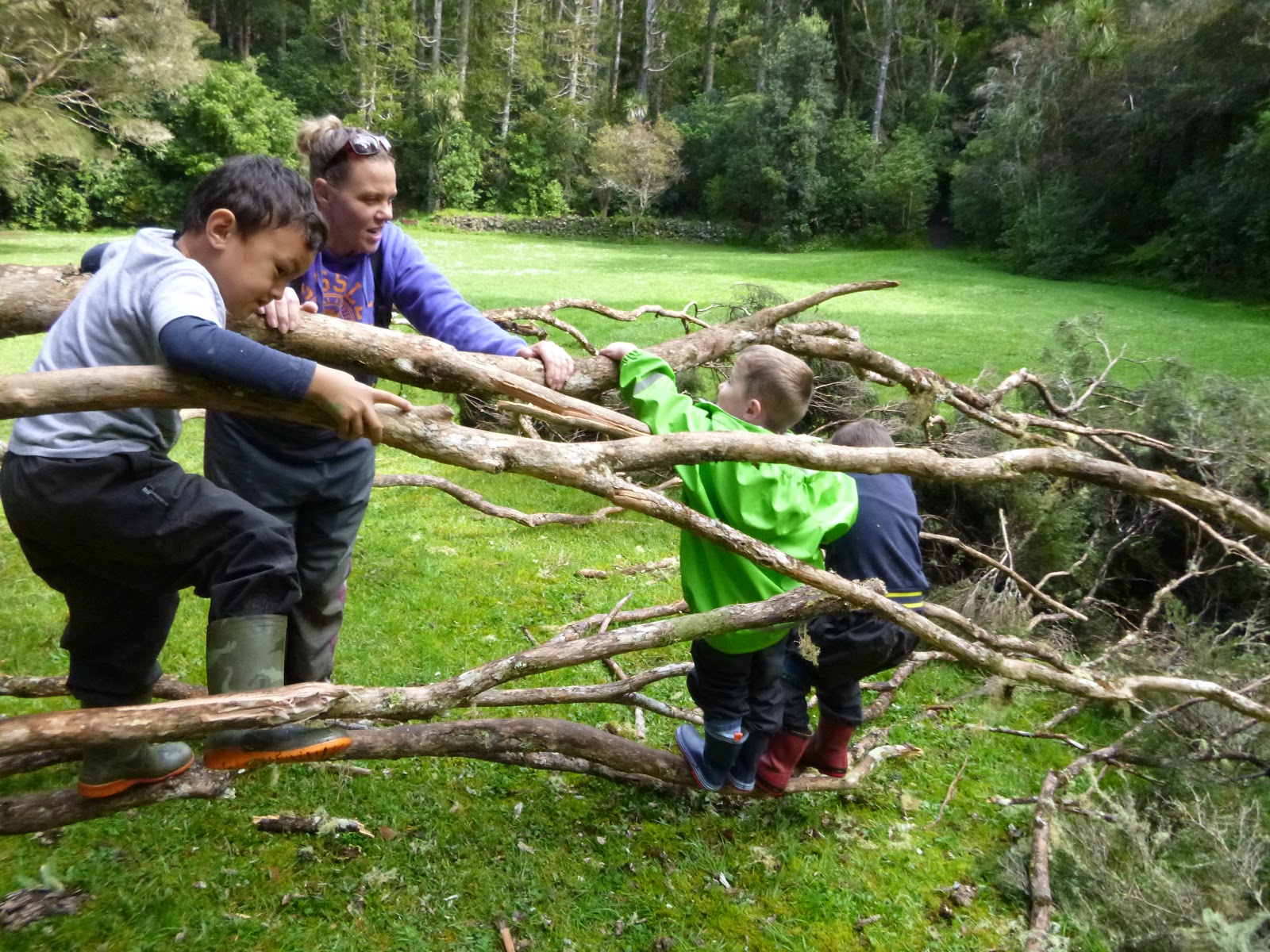
Last month when on our usual nature programme excursion we made a surprise discovery in an area that our children aptly name ‘The Meadow’, there was an enormous ti tree that had fallen and was lying on the grass.  We ran over for a closer inspection and it seemed even bigger, we all stood there staring at the tree, then wondered... what happen to the tree?  How did it fall down?  When did it happen?

“In every walk with nature one receives far more than he seeks”.  John Muir

This initiated a group discussion about what may have happened to the tree.  It was wonderful how our children seemed to put such effort into thinking about the tree and developed some great ideas that they were willing to share with the group, including;

Dre:  Someone cut it down
Ryker:  Thunder broke it down
Carter:  Thunder smashed it down
Dre:  I think the wind broke it down
Ryker:  It was a big giant that pushed it down
Carter:  Maybe someone swinged on it
Lucas:  I think a life cut it down
Dre:  I think a tiger cut it down
Nika:  I think the wind blew it down
Mayson:  It split
Isla:  I think someone cut it down or a hammer
Archie:  A chainsaw
Mayson:  Someone pushed it over
Archie:  I think a giant pushed it over


I loved hearing all the children’s theories about what may have happened to the tree, it certainly was an interesting start to our nature programme.  When we had a closer look at the tree and its split trunk, we were still wondering how it ended up on the grass, however there was the added bonus of it becoming the best adventure playground that nature has to offer!  So we began our explorations of the tree, by climbing, balancing, hanging, crawling, bouncing, jumping, walking and sitting on it. 


Carter had a great idea of getting the saw and other real tools that we carry on the nature programme out of our gear bags.  This was a brilliant idea as the tree provided many sawing options as there were lots of different branches to choose from - thin to thick.  The children were awesome with taking turns and sharing the saw with each other and offering encouragement to keep sawing when needed.  We spent a considerable amount of time, in fact most of our morning discovering new ways to explore the tree.


The weeks after the initial discovery, our nature programme children were keen to keep revisiting the tree and would spend the majority of the morning exploring it and all the challenges that it may bring, finding different ways to incorporate it into their play and seemingly enjoying all it has to offer.  I loved how some of the children would report back to me that the ti tree, that had provided so much joy, was still there. 


Last week when it was my turn to lead the nature programme (also it was the first time for the new term) we arrived at ‘The Meadow’ our excitement quickly faded for a little while as we realised that the tree had now completely gone.  We will miss the fallen ti tree and all the wonderful learning opportunities and experiences it offered.  That’s the beauty of the nature programme no two weeks are the same.


The natural world is a playground and place of discovery for adults and children alike, it is a place for adventure, exploration and imagination as well as generating a deepening care and connectedness with our environment. (Department of Conservation, 2011)

I am passionate about our nature programme and feel privileged to be part of it.  It is even more special when we get a wonderful surprise, like the fallen ti tree. It wasn’t only the children who enjoyed the tree, I also loved climbing on it.  It brought back all my own special childhood memories of climbing trees.  There are just so many benefits for our children, when they connect with nature.  The Department of Conservation states that many studies show the positive links between direct experiences in nature and children’s mental, emotional, and physical health and well-being.  The studies show that regular direct access to nature can; increase self esteem and resilience against stress and adversity.  Improve concentration, learning, creativity, cognitive development, cooperation, flexibility and self-awareness. (Department of Conservation, 2011).

Mā te wā
Susie

Translate