Haere mai! Welcome to Mairtown Kindergarten's blog.

Nau Mai Haere mai. Welcome to Mairtown Kindergarten's blog.


21 Princes Street, Kensington, Whangarei, New Zealand

Phone: 09 437 2742

Email: mairtown@nka.org.nz

Thursday, 3 May 2018

The Story Continues: Capturing Children’s Thoughts and Ideas (Thinking about Sunflowers)


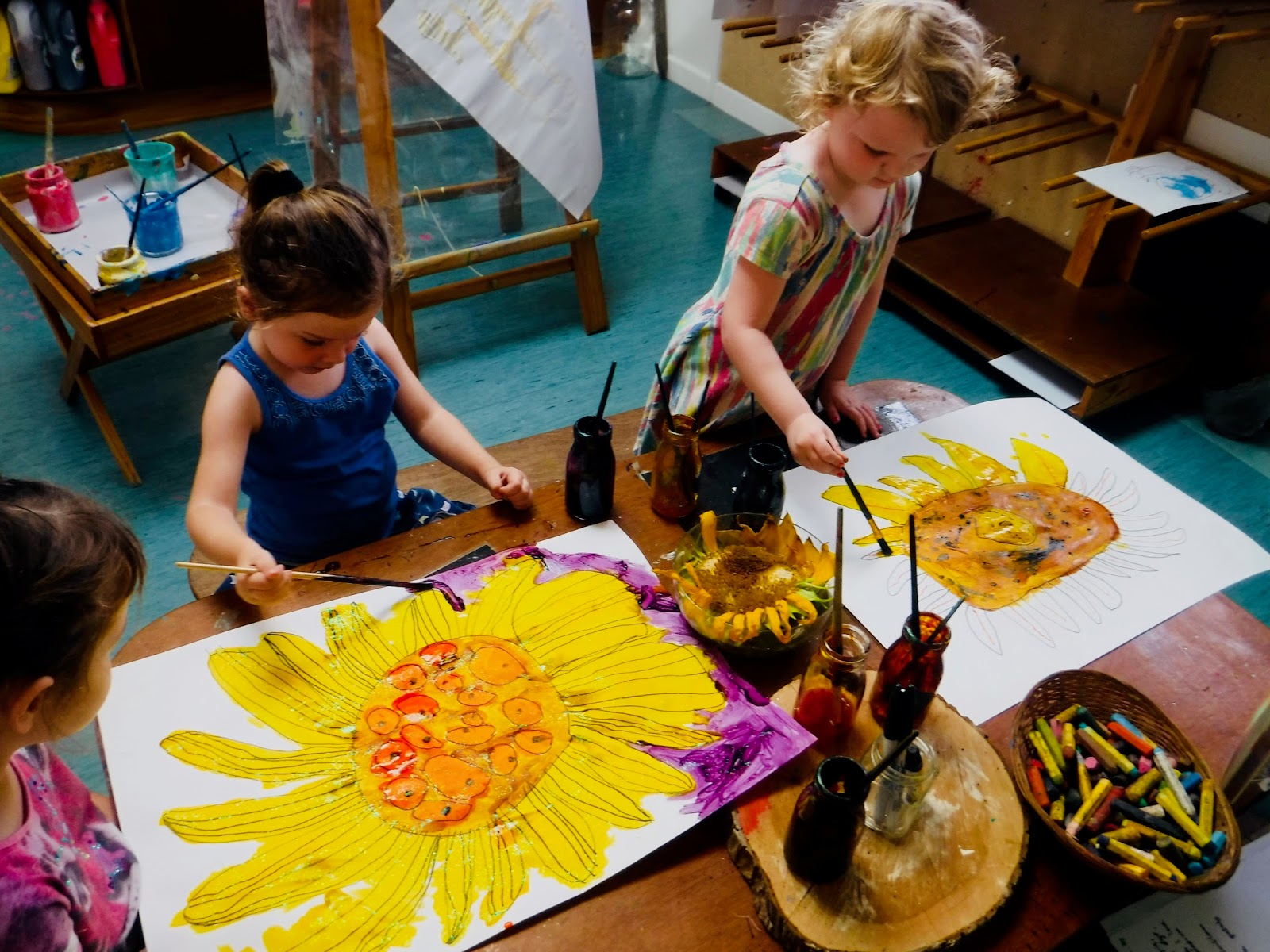
Last term I wrote about the beginning adventures of our some of our work with sunflowers, I mentioned how we spent a great deal of time wondering, questioning, examining and making discoveries about these beautiful flowers though our use of observational drawing. Many of our children at Mairtown have fully engaged in these opportunities to draw, but for those that chose not to, they still participated by watching their friends with interest and certainly joined in the many lively conversations we had been having as they carefully examined the flowers. These conversations have generally revolved around the three questions I used to guide the children’s thinking: What do you know about sunflowers? What do you notice as you look at the sunflowers? And What do you think or wonder about? (to read the original post from a couple of months ago click here).


Our conversations and discoveries have certainly been enlightening and very rewarding. As the children have each discussed their own knowledge, observations, thoughts and wonderings they have shared these with me and their peers. What I love when listening to children working together in groups, is when their ideas don’t always match those of their friends – when they disagree!  This is when thinking really opens up, more debating happens which of course enhances the learning for all involved.


'Remarkable things can happen when children work in small groups investigating topics that fascinate them as they build on each other’s discoveries and explanations'. Ursula Kolbe


However, as time moved on and our work gradually progressed we began to discuss the idea of translating the stunning 2-dimensional drawings and paintings that had been created, into 3 dimensional sculptures. As their teacher, my aim here was to continue to pursue the children’s interest in these gorgeous flowers, in particular the structural element of them, to encourage the children to continue their work as the self-motivated scientists they had become so far. So, with a focus on structure, detail and texture, (I really felt we needed to use a textural resource), we initially turned to clay. At Mairtown we are very familiar with using clay, so this also seemed a natural choice for the children and one that everyone was happy about, diving eagerly in.


Thinking in three dimensions demands an imaginative leap, and the plastic malleable nature of clay makes it an ideal medium for learning about form (NCCA).

Clay is a medium we value greatly at Mairtown, and it’s for that reason that it is available almost every day for the children to explore and create with. One of the great things about clay is that it is highly responsive to touch whilst also being very forgiving. As soon as children pick up their clay they instinctively begin to mould and shape it. It is them that is in charge and they soon realise they can command the clay’s movements through their own self-expression and imagination. The other benefit, is that it allows children to try out a theory, make a mistake, and then alter it if this wasn’t quite right or what they had in mind.


Making mistakes is essential for self-improvement but can be difficult and even an obstacle for some children. The forgiving quality of clay, and therefore the ability to readily fix mistakes, gives the child a sense of control over their projects success which improves self-esteem and self-expression as they realise that mistakes aren’t going to stop their progress. (P. Storms)

As we sat down to begin creating our sunflowers, it became clear how engaging in clay work (like drawing) is also a language for children to explore and communicate all their ideas. The clay allowed the children to revisit their past drawings, or for some that hadn’t engaged in drawing, their past conversations and observations. With the clay the children looked at the outline of the sunflower, the way it stands up, the thickness and length of the petals, incorporating this thinking into each sculpture.


Like drawing, clay work enables children to make their ideas visible – but in three dimensions. It can be an exciting experience for children to discover that they have made something with a ‘back’ and ‘sides’ as well as a ‘front’, and even an ‘inside’ and an ‘underneath’ (Kolbe, 2009).

Seeing how eager and involved the children were in this work, I opened up the idea that they could also choose to add any other resources to their work in order to create their final sculpture.  Some of the resources the children choose to draw upon were beads, feathers, wire and paint, whilst a selection of tools the children used in order to assist them in their work were bowls, sticks, fabric, wire cutters, pliers and hot glue guns.


A few children seeing the wire choose to create their whole pieces with this resource, interestingly a resource that is still fairly new to them, so therefore this took great practice and learning, in order to gain control over. Wire is much trickier to control than you initially think. For example, Max noticed when he worked on his wire petals, ‘Just as I get it right, it moves again into something else!’


Enabling children to revisit and therefore revise their ideas about sunflowers is an essential aspect of learning. Each new resource offered to the children drew attention to a different aspect of the flower. By using a range of different tools, techniques and materials they were truly able to explore an idea in much greater depth and from multiple perspectives. For instance, many children were able to use their original drawings to guide their sculptural work, and I am wondering if some may take the opportunity to now use their sculpture to refine their drawings, based on their new discoveries?


Sculptural work, is fascinating and takes over the whole body, indeed often quite literally requiring the strength of the child’s whole body to manipulate the desired material into position. Watching the children at their work, I was mindful not to question as I had in our earlier work with drawings. I let the children talk to me and of course responded, but I felt my questions would have distracted them from their deep and meaningful exploration. I didn’t need the children to verbalise their thinking, knowledge or learning. Quite simply by watching them at their work, as they created these beautiful pieces, I could see the knowledge, the thinking and the learning each individual child had discovered about the sunflowers. The perspective of each child is quite clear when you look at the finished sculptures.

Each time children re-visit their work, their thinking deepens: they recognise inconsistencies, notice new details highlighted by a particular medium, and see things from a new perspective, or discover connections among them (Pelo, 2007).


The variety of work has been amazing, and each sculpture is so different. Even though I kept my own dialogue to a minimum during the children’s work, most children did choose to revisit the questions we have pondered on earlier at some point, What do we know about sunflowers, What have we observed about sunflowers, and What we wondered about with sunflowers? Most of this sharing occurred at the end of their work. Perhaps this was when their minds were free to discover what they had sculpturally created and to then use this as a visual cue to explore their thinking at an even deeper level.


Here is some of this thinking:

Georgia: Some petals are not fat, and some are fat…I need to leave space here for the stalk…all sunflowers have petals and they have stripes on the petals and on the stalks. If they didn’t have stalks they would fall to the ground. Sunflowers are so soft, and they need lots of sun.


Max: I made it all metal, it’s a sunflower made from beads, orange and yellow. So, you see, sunflowers have petals, seeds a stalk and leaves. They need lots of water and sun too. I really like this (looking at his sculpture) it’s cool, It looks like a real sunflower but it has a stick instead of a stalk.


Amelia: The petals are yellow and see, they have lines. I’ll do lines too after I painted them yellow. They have lots of seeds, brown and black and brown and black. The stalk is taller (than I have made), but I can’t do mine taller, it too falley over if I do that.


Painting is so poetic, while sculpture is more logical and scientific and makes you worry about gravity. Damien Hirst


Ngā mihi nui,
Christine


Tuesday, 3 April 2018

Literacy on the go


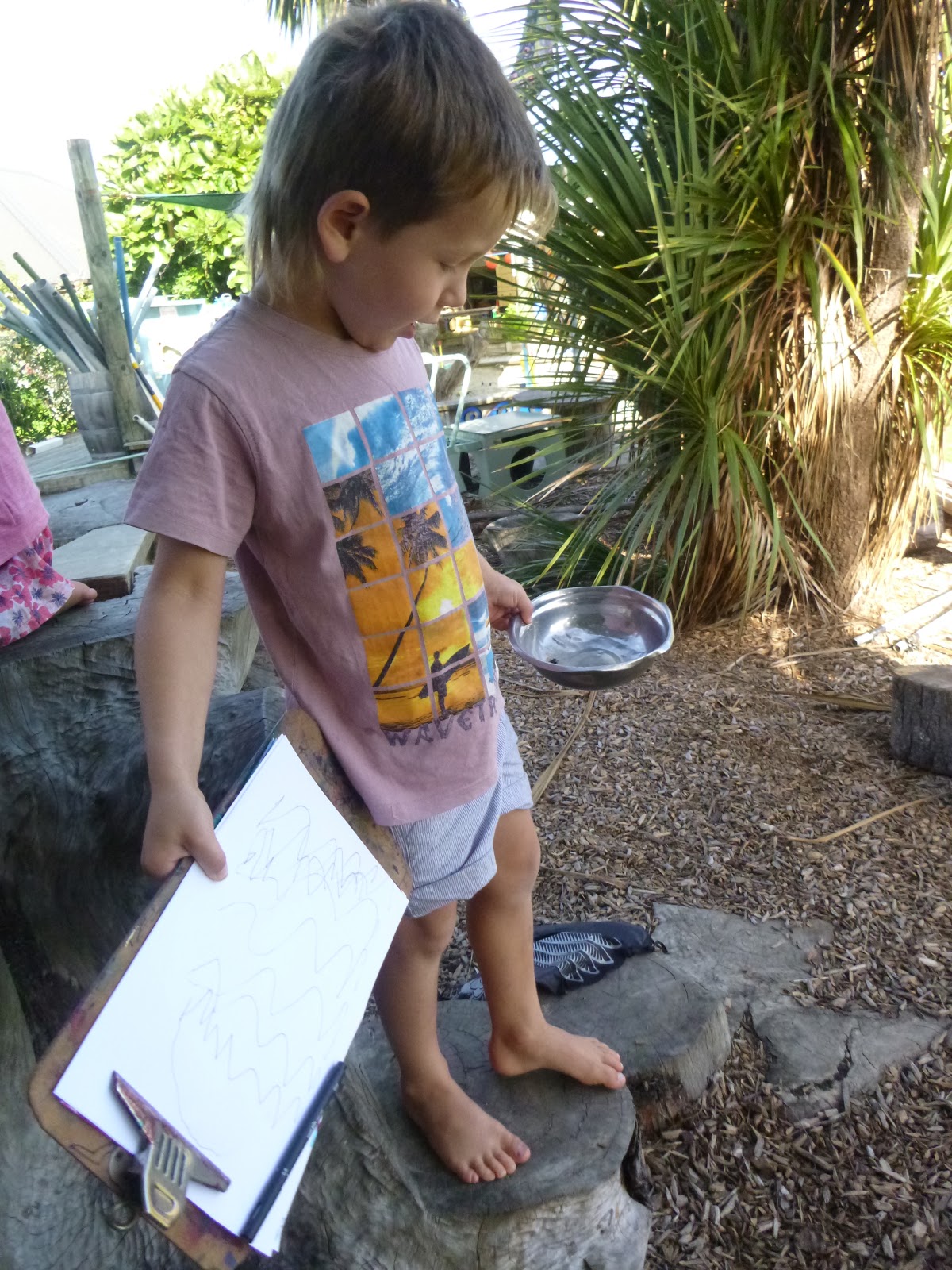
Recently I have noticed how many of our children seem to love our clip boards and I started to reflect on how essential clip boards are to our environment, so much so, that I can’t even imagine not having any around.  There isn’t a day that goes past without the clip boards being used somewhere and yet they never get much of a mention, they are not really glamorous, however, they are indeed a very valuable and much loved resource at kindergarten.


At Mairtown we love open ended resources and clip boards are just that, an open ended resource that can be used in many different areas in the kindergarten and for our children to use to express their own ideas, feelings and thoughts.  The teaching team puts a lot of effort and great thought into our entire environment. There are baskets of clip boards available not only inside but also the outside environment too, always readily available with pens, pencils, crayons and paper.  It is a wonderful way to encourage and weave literacy throughout our environment.

“When children have access to loose parts, it frees their creativity and imagination to change the world around them in infinite ways.  The more flexible are the materials in their environment, the greater the level of creativity and inventiveness they express.”  Polly Neill, 2013


When I think of the clip boards from a child’s perspective, it is no wonder that they are so well loved as most kindergarten aged children love to transport; that’s moving things from one part of kindergarten to another as their play unfolds.  That is what is so ideal about the clip boards as they can literally be ‘literacy on the go’ as a child moves around kindergarten, for example, from the construction area to water play and back inside to the family corner.  I love how our children don’t seem to mind where they get creative using the clip boards.  Early literacy isn’t limited to sitting at a table and chair with pencil and paper, using clip boards enables children to be wherever they choose, whether it’s sitting on the log resting the clip board on their lap or at the playpod equipment sitting in their ‘car’ drawing a map or lying on the grass drawing.


You can’t use up creativity.  The more you use, the more you have.    (Maya Andrews)


On many occasions I have seen the children carry their clip board around proudly showing their work to others, or inviting peers to add to their work or play.  In a sense, clip boards can become an essential tool for creating social interactions with other peers, as a way of expressing their feelings, thoughts and ideas and communicating these through drawing.


When drawing is used as a tool for communication, children are able to express themselves and make meaning out of the world around them. Using drawing as a means of communication helps the process of making ideas, thoughts, and feelings available to others (Adams, 2006).


I believe the one of the main benefits of having clip boards available is to support children with their early writing development, I don’t mean this as a time of learning how to write the alphabet, I view it as an important opportunity for children to learn how to make marks and representation on paper.  It is about providing children, through their play, with opportunities to encourage early literacy. For instance this could include; drawing plans, signs, maps, letters, counting down crossings, lists, and tickets.


If children are to begin to see themselves as writers it is essential that we provide them with opportunities to role-play and to make marks and representations on paper.  (S Palmer, R Bayley, & B Raban, 2013).


I’m sure that we all know children learn best when they learn through play.  It is when these play experiences have been woven with early literacy that there are many benefits to our children’s lifelong learning.  So the next time you see a clip board, hopefully you will think of it as a very valuable resource.


Mā te wā
Susie

Thursday, 8 March 2018

Wheels-a-thon 2018


There had been a sense of anticipation building at Mairtown Kindergarten in the last few weeks as we approached one of our most loved annual events – Wheels-a-thon! We had been taking the opportunity to count down the days on our calendar when we came together at whānau time each day. Many of our children also have memories of attending this event last year, or have had older siblings at Mairtown Kindergarten and had attended a Wheels-a-thon with family previously. For those who were first time attendees (like myself!) we had been watching a video from Wheels-a-thon 2017 which has given us a good idea of what we might expect and allowed our own excitement to build!
The New Zealand Early Childhood Curriculum Te Whāriki  empahises the importance of this process for children:
“Kaiako talk with children about upcoming events … so that they can anticipate and be comfortable with them” (Ministry of Education, 2017)


The biggest learning on the day came in the form of an unexpected challenge … It rained – quite a lot! I had been reliably informed that it never rains for Wheels-a-thon, but this year Ranginui, the sky father, had other ideas!!

Our children and their families were wonderful role models for resilience – it would have been easy to look around at the weather and think negatively about the situation. But in the famous words of Pete the Cat, “Did they cry? Goodness no!” All of the families and children showed up in the rain, with beautifully decorated bikes, scooters, balance bikes and even push chairs and made the most of being with their friends, racing around the wet track with their eyes bright and shining. We were so proud of their positive ways of being.

                “Life is not about waiting for the storm to pass, it’s about learning to dance in the rain”


This event allows us to generate much needed fundraising money for Kindergarten so that we can continue to deliver a quality experience for our children and their families. The support from our whānau both through participation on the day, and gaining sponsorship is invaluable to our Kindergarten and so so appreciated by the Mairtown team!

                “Alone we can do so little, together we can do so much” (Helen Keller)

We hope you enjoy the beautiful video of the day below, which has been cleverly prepared by Christine.


Arohanui,
Amy


Translate