Haere mai! Welcome to Mairtown Kindergarten's blog.

Nau Mai Haere mai. Welcome to Mairtown Kindergarten's blog.


21 Princes Street, Kensington, Whangarei, New Zealand

Phone: 09 437 2742

Email: mairtown@nka.org.nz

Tuesday, 7 March 2017

Collaborative Art Pieces: Working towards a common goal


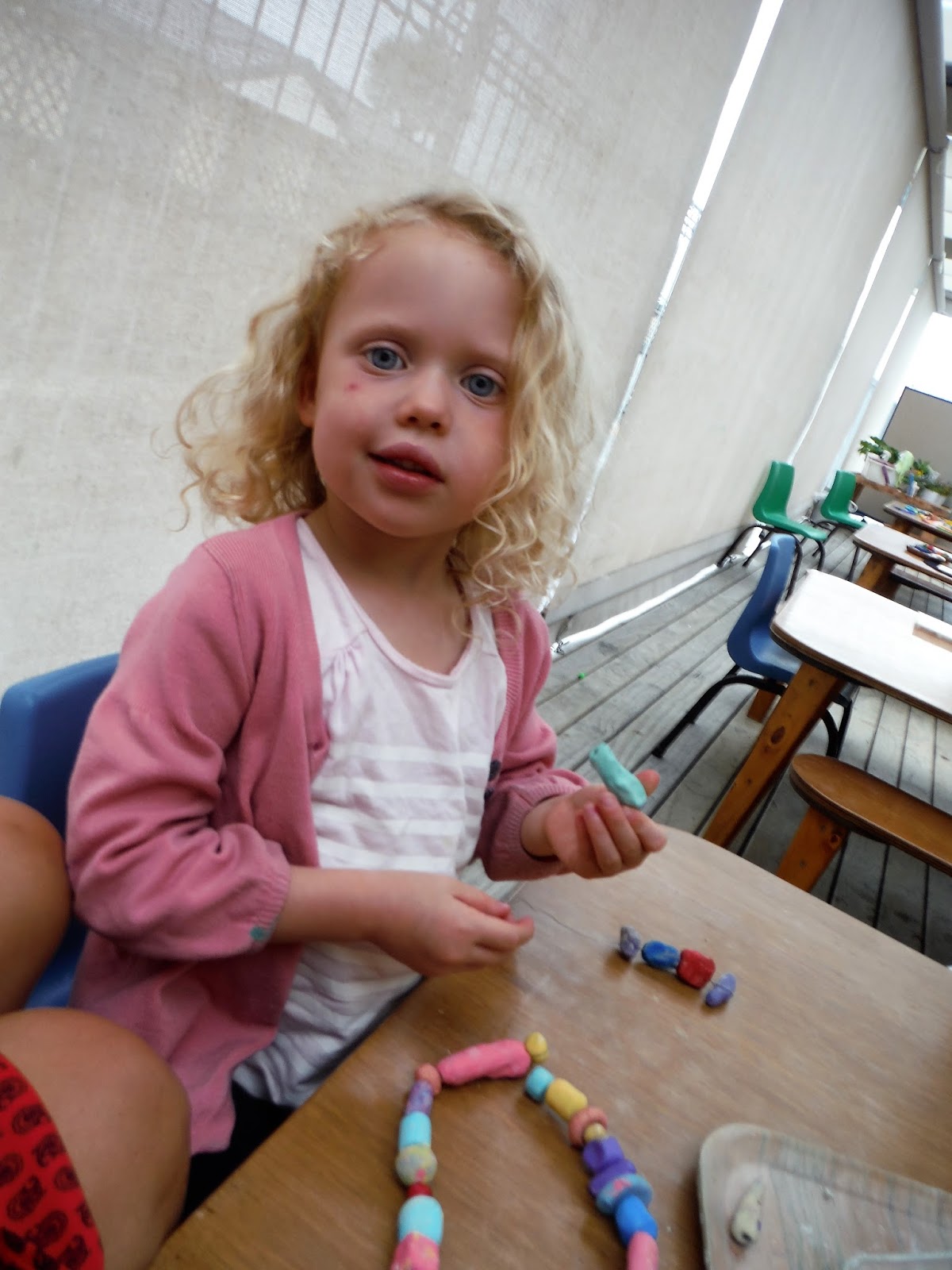
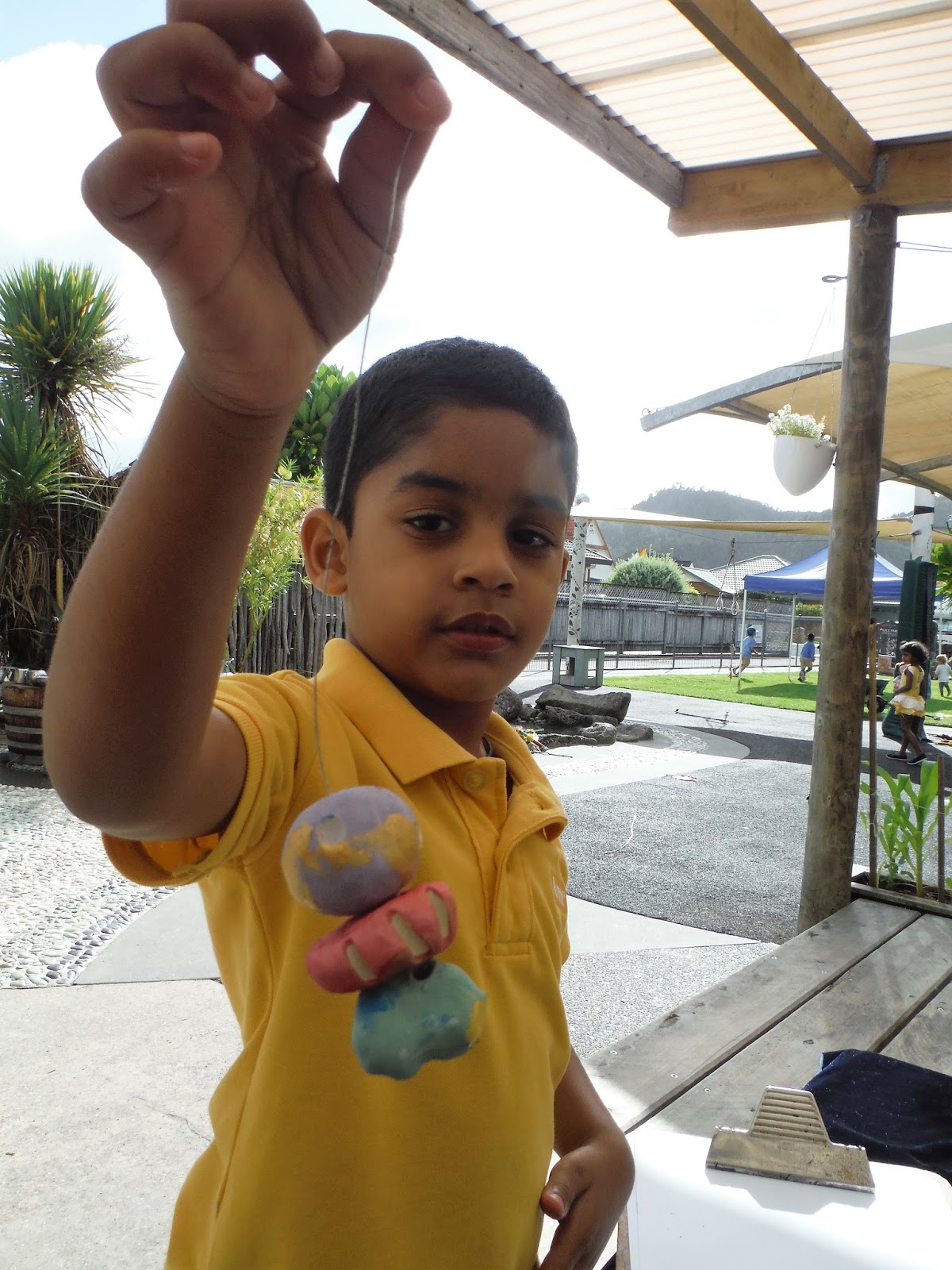
Just recently I was doing some work with the children that required them to share the ownership of a piece of art. The children were shown a provocation, a photograph of many beads that had been made using clay and then threaded together to make a ‘person’. Some of the children involved in this activity followed the whole process through from making beads with clay, painting them and then threading them together. Others joined in at different stages of the journey. Whatever the situation was, I took time to talk to them about how this was an art work that we were making together for everyone to enjoy.


“Children’s development occurs through active participation in activities. Collaboration with adults and with other children plays a central role in this development.” (Te Whāriki, 1996)


This brought to light for me the fact that we have a lot of children at Mairtown kindergarten who work well in collaborative situations. This art experience is just one example of how our children competently work together and happily share ownership of products that are produced in the process. In this case it was two lovely beaded people made by many children over a few weeks.


When the art works were displayed I noted that some of the children were discussing different parts that they had contributed to.

“I made that head.” (Juno)

“I did lots of painting the round things. (Wai Manu)

“I did lots. I did making the clay. I did painting. I did putting them together. I did it with other people.” (Willow)

“I did lots of cool painting on this persons beads, lots of different colours aye.” (Archie)


Collaboration -The process of two or more people working together to realise or achieve something successful


To work together and achieve a common goal is a wonderful concept to appreciate and have an understanding of. As I worked closely with the children we discussed how we were working on a project together that would be on display for everyone to see. On one of these occasions Raina and Cleo had a great conversation about what they thought collaboration was.


Cleo: “I know what that means, it means to work together, to get things done good.”

Raina: “I know what it means because Cleo, you just told me. I work together with my friends and my family. We are making these beads beautiful together. I think my Mum will love them and my Dad.”

Cleo: “Yeah, we are making them beautiful together, aye Raina. Everyone will like them.”

Raina: “It’s good working together isn’t it!”


We love to celebrate collaboration at Mairtown Kindergarten. We believe it is a wonderful skill that will support children throughout their learning journey.  Collaborative art is one means that we use to support and foster this. These art pieces were made by lots of children for lots of people to enjoy.


Till next time,
Zair


Tuesday, 28 February 2017

Nau mai haere mai

Nau mai haere mai a matou whanauwhanui,
Nga mihi motu tau hau.
Haere mai, haere mai, haere mai.
We all welcome you here today, our new whanau and those returning,
We acknowledge you and greet you.
Welcome, welcome, welcome.
On Tuesday 14th February, we invited all our new whanau and existing whanau to come and join us for a shared kai to welcome Archie, Isla, Aris, McKenzie, Aya, Alfie, Adam, Wai Manu, Lachlan, Max, Juno, Sandinsa, Imogen, Charlize, Nathan, Piper and Ryley and their whanau to Mairtown Kindergarten. It was great to see the abundance of whanau who came along and a huge thank you for bringing in all the delicious kai, it was amazing.


11.45am rolled around quickly and we gathered all the excited tamariki for a whanau time before lunch and Kate got up and said a welcome in Maori, Zair followed with another warm welcome. For a few weeks leading up to the shared kai, tamariki had been learning a new waiata ‘Tena koutou’ with Christine at whanau times. We have had such fun with this waiata, it’s an echo song so Christine would lead us off and we would echo it back. Such a lovely waiata which was very fitting for this special occasion. The tamariki were professionals when it came to performing, standing up all tall and proud, singing their hearts out, they did a fantastic job.
 

He aha te mea nui I te Ao?
He tangata, he tangata, he tangata.

What is the most important thing on earth?
It is people, it is people, it is people.
 
"I liked singing the echo song" Milla.
"My Mum made brownies for lunch" Archie.
"Got to share all the yummy food with everybody" Dre Varn.
"Nice to welcome everyone to kindergarten" Zoey.


We all got to share a delicious kai together, it was nice to get to know some of the new, extended whanau and to see so many new faces here at Mairtown Kindergarten. It was great to see some of the whanau, that don’t come in much due to work etc, arrive and get a chance to look around the fun and exciting environment we have here.
Ehara taku toa I te toa takitahi,
Engari he toa takitini.
Success is not that of one,
but the work of many.
Relationships and partnerships, based on trust, respect and open communication are central to our philosophy. Kanohi ki te kanohi (face to face conversation) is something that we value immensely. When these genuine, authentic and reciprocal relationships are established, Mairtown Kindergarten becomes a safe and secure place for children, whānau and teachers, and this secure environment supports children to explore, play freely and fosters their ability to be learners and leaders. We believe that everyone in our learning community is beautifully unique and has a wealth of knowledge, which we love to honour…(Mairtown Kindergarten Philosophy).

 Nau mai haere mai, welcome to Mairtown kindergarten.
 

Friday, 10 February 2017

Random acts of kindness


The beginning of term one at the start of a new year is always an exciting and sometimes a nerve wracking time for our children as there is plenty of catching up to do of old friends reconnecting and also we have many new friends start at kindergarten.

At Mairtown we place a lot of emphasis on creating an environment where new rangatira (leaders) are promoted to show kindness and manaaki (care), towards each other.  Even though at the end of last year we had fifteen children transition to school this created a wonderful opportunity for other children to step up and show their kindness towards their friends especially our new children.

“A warm smile is the universal language of kindness”. William Arthur Ward

Kindergarten can sometimes be a busy place and when it is a completely new environment for a new child and their whānau it may seem a little overwhelming, this is where a little kindness goes a long way.  The thing about showing kindness is that it doesn’t have to be big, it may start by giving someone a smile or maybe sharing kind words, or a small gesture which can change our mood and brighten our day bringing us closer to the giver.  This is wonderful when building new connections as kindness is good for relationships and it seems that kind people are more empathic.  Each act of kindness might seem small, but it’s actually changing the way we see ourselves, the way we see others and the way others see us.

“If we all do one random act of kindness daily we just might set the world in the right direction.”  (Martin Kornfeld)

Since the start of this term I have been privileged to see many random acts of kindness and hear many comments amongst our children that just makes my heart sing, like; “Go like this then you can do it, yeah I’m so proud of you” “I can help fill that for you” “Here you can have two and I will have one” “Come on and play with me” “Here you can have my swing if you like” “She’s my new friend we have been playing inside” “Here I’ll put that away for you”.
“Kindness means you are concerned about other people.  Kind people think about another person’s feelings … they help someone who is in need, and they are kind even when others are not.  Kind people never expect anything in return.  They just treat other people kindly because they want to help make someone’s life better.  Kindness makes the world a nicer place, because it makes people happier”.  (Dr. Michele Borba)


I know some people think kindness doesn’t matter compared to other important areas of learning for instance literacy and numeracy.  I realise that kindness isn’t a curriculum area but actually I feel it should be as it is valuable skill, important for lifelong learning as well as wonderful way for children to start building relationships while making new friends.  I think this quote sums it up nicely, “Don’t become preoccupied with your child’s academic ability but instead teach them to sit with those sitting alone.  Teach them to be kind.  Teach them to offer their help.  Teach them to be a friend to the lonely.  Teach them to encourage others.  Teach them to think about other people.  Teach them to share.  Teach them to look for the good.  This is how they’ll change the world.”  (Collective Evolution)

When I noticed our children doing all these wonderful random acts of kindness we ended up talking about what kindness is or how we can show kindness to our friends, here is some of the discussion:
Capri: “Be friendly”
Elsie: “Play with them.  The other day I was helping my friend to swing himself.  It’s nice to have a friend”
Aya:  “When we have cuddles”
Raina: “To help people”
Noah: “When we take turns and play together”
Inura: “Pushing them on the swings.  I have lots of friends.  I gave my dinosaur toy to baby Evie.  It made me happy”
Arlo: “Spinning them”
Inura:  “Austin did a great job helping Zoey when she got hurt.  He made her feel really special.
Tilly: “Maybe by telling them we love them, maybe we can play games that they want to play”
Isla: “Play with them”
Ella: “Be nice to them”
Tilly: “I’ve been pushing Fern, Ella and Isla on the swings”
Ella: “I asked Fern if she would like to have my dress”

There are many benefits for children’s learning and development especially their social literacy when they receive and share a little kindness and the best thing is that to give a smile or say some kind words is free and can make everyone feel so much happier. 

“Everywhere you go, leave a glitter trail of kindness behind you”. Author Unknown

Mā te wā
Susie

Tuesday, 31 January 2017

Building relationships through art

Over the last week all the Mairtown tamariki have begun to return to kindergarten after their long 4-week summer holiday. This year at Mairtown we have 15 new children and their whānau starting with us, and whilst kindergarten is a familiar place for the remainder of our children, whether you are new or not, returning after so many days away can be an anxious time for many.


Obviously, all the teachers at Mairtown like to try and ease this anxiety as much as possible and one way we do this is by focusing on individual relationships and a child’s sense of belonging. I know, and have seen first-hand, how important this is. All children need to feel that they are in a safe environment where they are cared and loved by the people around them, where their individual needs for support, respect and friendships will be met and that if they encounter any problems they know that they have people who they can turn to for help  – with this comes a sense of belonging.


Relationships within an early childhood setting, I feel, are one of the most important aspects of enabling children to feel safe, feel welcomed and as if this is ‘their place’. We only need to reflect on the importance of relationships in our own lives and learning as adults; how positive relationships can empower us and leave us feeling fulfilled yet negative ones can drain us of energy and make us feel deflated. As our NZ Early Childhood Curriculum, Te Whāriki, states, “It is clearly acknowledged that the relationships and the environments that children experience have a direct impact on their learning and development.”


In the beginning weeks of a new term – especially after such a long break – I see my role as a teacher to be about gaining a sense of connectedness and re-establishing past (as well as working towards new) relationships with the children and their whānau.

This year on the first day of term, I was sitting outside doing just this. With a small group of children, I chatted about my holidays and they all opened and shared freely their experiences. Some talked about Christmas day, others camping, whilst some even shared more exotic trips abroad.

As these early days of the term have slowly passed and everyone has begun to settle back in, the topic of the summer holidays has continued eagerly, and more and more children have wanted to come and share stories and experiences with me and their friends.


As the children began to recount and reflect on their special events I asked them if they’d like to draw a picture to support their words. Art as a means of communication is something we value greatly at Mairtown and as the children began to draw it was clear they were each choosing very different experiences to reflect upon to one another – experiences for them that clearly carried meaning and importance.

Teacher and author Kolbe states that, ‘Drawing allows children to channel their thoughts in an uninterrupted flow from mind to paper’ and I believe this really happens. The drawings the children created were instinctive, simple and allowed our tamariki time to both draw and chat simultaneously; these two methods of communication go hand in hand and beautifully complement each other.


This particular work, is often referred to as ‘a language experience story’ or ‘recounting’.  Recounting is verbally describing familiar events and experiences. Recounting provides children with opportunities to talk about things…the choice of topic can often be left to the child (Genisio, 2008).

While most older children (for instance those at school) may be invited to write about experiences, younger children can share their personal experiences with others through completing a drawing whilst an adult can act as a scribe for their verbal words (Luongo-Orlando, 2010). What is interesting about this type of drawing is that it requires children to draw from memory – a very different skill to drawing from the imagination or from observation – and it requires children to think visually whilst also expressing themselves verbally. 


‘For children art is primarily a means of expression, and it becomes a language of thought, therefore it changes as the child grows. The fact that children interact and share ideas when they are drawing, shows that drawing plays a role in developing children’s vocabulary’ (Anim, 2012).

From my personal experience when I work with children on recounting stories through verbal and visual means, one of the most important things is to work in small groups of 2-4 friends. My initial aim when engaging in this work is to build relationships and connectedness and a small audience is very reassuring for children, as well as having the benefit of extending the experience of having a few friends who listen with interest, themselves then being inclined to share and recount their own personal stories.


As the teacher, I also have to be mindful to listen myself, and to stop chatting (which is quite difficult at times!). Whilst I have observed some children will chat and draw their recounts almost hurriedly in a rush to share their information, other like to think and ponder over the important elements of their stories.

Here is a selection of some of the recounts produced by our tamariki. I can’t help but feel that although this is devised as a means for extending literacy (certainly I have noticed vocabulary is always more detailed and expressive when in this type of work), it is a beautiful way to reconnect with the children, to share stories, to listen to one another, to learn and understand each other, to respect each other; to build our empathy, sensitivity and ultimately our relationships with one another and of course our sense of belonging.


Franchi: "My best thing was always going to the beach. I went swimming with Mumma, Juno and Aunty Rosie. I saw little fish in the water as I went under the water and opened my eyes with goggles. I had to keep my feet kicking cause then I can float, my arms were up the top. They were Raina’s goggles; she was at the beach. I climbed rocks, they were sharp. Raina’s on the top of the deep water and under the water too. We were swimming out in the ocean at Wellingtons bay. No mummies and daddies were there as they were on the boat, which had a big flag on it. I saw a big shark and Raina saw a big shark too. The water is really deep, I tried to stand up but my head was still under the water. Juno couldn’t go as only I can float. Juno was on the boat”.

Maxwell: "I went to Queenstown and went on the money digger. It was yellow and it swings around and it has a wheel you hold and it had controls up the top with buttons to press. It takes money to make it swing round."


Ryker: "Look, there were teddies at treasure island. I was in a tent at treasure island, it’s yellow. I went on a flying fox; it was so far far away. The flying fox went faster and faster and faster and faster.”

Carter: “I stayed at my land building as we’re building a house. And I stayed as my nanna and poppas for a sleep over – just me! I stayed up early, we went shopping and we buyed drinks and food and we got sprinkles (giggles with delight). I lived at the top”.


Drawing is a communication tool which children use to express ideas, not only in externalising their own thoughts but as a means of clarifying for others what it is they are thinking (Schiller, 2004)


Mā te wā, Christine

Translate